The Ricoh Watch Story
From Optics to Watchmaking
Ricoh is renowned for its copiers, printers, cameras, and a lesser-known fact is their involvement in manufacturing mechanical watch movements. Interestingly, Ricoh was the fourth Japanese company to develop in-house mechanical watch movements, following Seiko, Citizen, and Orient.
The company's history traces back to 1936 when it was established as Riken Kankoshi Co. Ltd., later rebranded as Riken Optical Co. Ltd. in 1938, focusing on optical devices such as cameras. In 1963, the company evolved into Ricoh Co. Ltd., establishing itself as a successful multinational entity. Delve into their wide-ranging product portfolio spanning beyond office machinery to encompass the realm of precise timekeeping.
Inheriting a Legacy
The origins of Ricoh's watch division stem from another Japanese firm, Takano Seimitsu Kogyo Co., which was founded in 1938. A pivotal moment occurred on May 8, 1962, when the president of Riken Optical Co. Ltd. assumed the presidency of Takano. Subsequently, in August 1962, Takano Seimitsu Kogyo Co. was rebranded as Ricoh Tokei Co. Ltd. Later, in 1986, it underwent another name change to Ricoh Elemex Corporation, a company that remains operational today.
By reading about Takano on this website, you can immerse yourself in the captivating history of this entity, which faced insolvency in 1961 following the devastation caused by a typhoon that ravaged their factory. My focus lies primarily on the early Ricoh models influenced by the talented engineers who transitioned from Takano to contribute to Ricoh's advancements.
Ricoh Edition — Preface (Ricoh-hen Jobun)
The management crisis of Takano Seimitsu Kogyo Co., Ltd. (hereafter referred to as "Takano") became evident in November 1961 (Showa 36), when the company fell into a state of "no dividend" for its shares.
The primary cause was widely attributed to the devastating impact of the "Isewan Typhoon" (Typhoon Vera). Indeed, the damages amounted to a massive scale of approximately 140 million yen, which was undoubtedly a major factor. At the time, the company's total debt was said to have accumulated to 3 billion yen. This was largely due to chronic poor business performance caused by excessive capital investment and a chain of sluggish profitability in the sales department, rooted in low brand recognition.
— The Search for Business Partnerships
From around the fall of 1960, a group of banks, led by the then Sumitomo Bank and Tokai Bank, took center stage in exploring a reconstruction plan based on business alliances. Approaches were made to potential partners such as Sanyo Electric, Okuma Iron Works, and Yazaki Meter, but all these attempts ended in failure.
Amidst this, a partnership with industry leader "Seiko" became a strong possibility. However, just as the plan was progressing smoothly through the mediation of the bank group, an unexpected objection was raised from an unforeseen quarter.
— Intervention by the Ministry of International Trade and Industry (MITI)
The then Ministry of International Trade and Industry (with Bureau Chief Eisaku Sato) expressed the view that "Takano was nurtured by this Ministry from the planning stages of its clock manufacturing as a competitor to Seiko, in order to improve the production technology of the clock industry, which the Ministry saw as a promising major export industry. Therefore, a merger or absorption by Seiko would be meaningless."
Consequently, the Ministry stepped in to mediate with Kiyoshi Ichimura, the leader of the San-ai Group and President of Riken Optical, at a time when negotiations with the bank group had stalled. It was extremely unusual even at that time for the Ministry to intervene in the reconstruction of a single company in the Chubu region. This intervention was backed not only by the aforementioned circumstances but also by strong pressure from the Chubu financial world, including Governor Kuwahara of Aichi Prefecture.
— The Road to the "Ichimura Plan"
In March 1962 (Showa 37), Mr. Ichimura, upon receiving the request, initially declined the partnership. His reasons were the sheer size of the debt, the practical impossibility of repayment using Takano's existing production facilities, and the lack of transparency in cooperation with the labor union. The bank group was unable to provide a clear response, and negotiations reached a deadlock.
However, the "Ichimura Plan" was seen as the last resort. This grew into a large movement involving MITI and the financial world. In April of the same year, a reconstruction plan centered on a loan of 1 billion yen was proposed. Mr. Ichimura, viewing it as a matter that "could no longer be settled by a single company or individual," finally decided to accept the proposal.
— Legacy and Recovery
Despite being hailed as a "rare manager" who established various successful enterprises, entering the "clock industry" proved difficult, and by the financial results of March 1965, the company was again forced into a "no dividend" status. From this critical situation, he managed a remarkable turnaround through his innovative thinking and advanced management skills, leading to the company's current state.
Ricoh products reflect his motto, the "San-ai Spirit" (Love people, Love your country, Love your work), showcasing a commitment that sets the company apart from others.
Ricoh Dynamic Auto — 33 Jewels 1962
 SOLD
Originally released in October 1962, the Ricoh Dynamic Auto timepiece features a prestigious 33-jewel movement known for its immediate day and date change mechanism.
From our archive — a Ricoh Dynamic Auto we've had the pleasure of selling
Coming soon — in transit from Japan
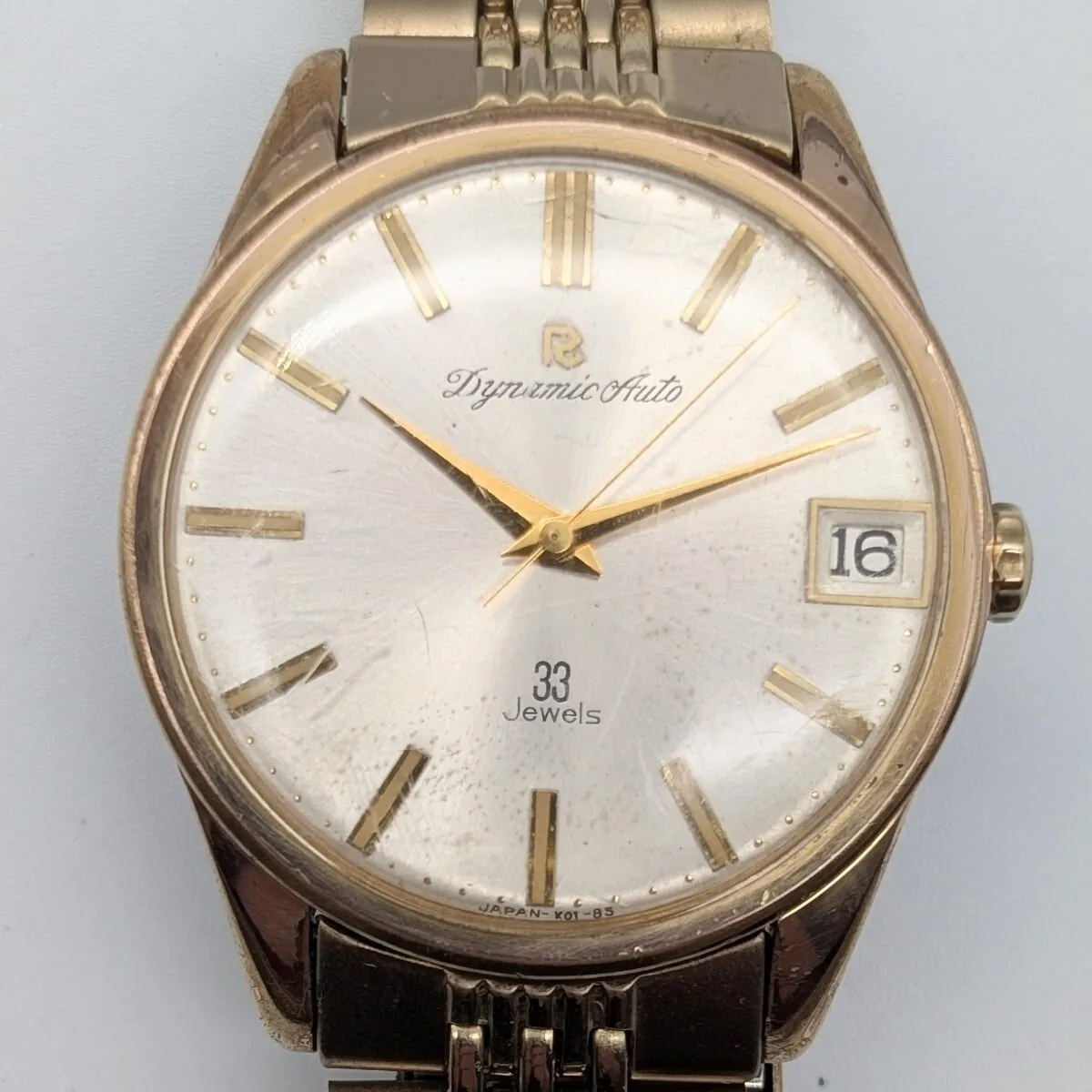
A gold-plated Ricoh Dynamic Auto 33 Jewels with date, whose caseback is still signed "Chateau — Automatic Calendar", Takano's top line. After Takano's insolvency, Ricoh first used up the Takano casebacks it still had in stock, and this is one of them. A new crystal will be fitted before sale, and the price will be announced on arrival. Read the full story or see it in the shop.
Ricoh Dynamic Escort — Day'n Date 1962
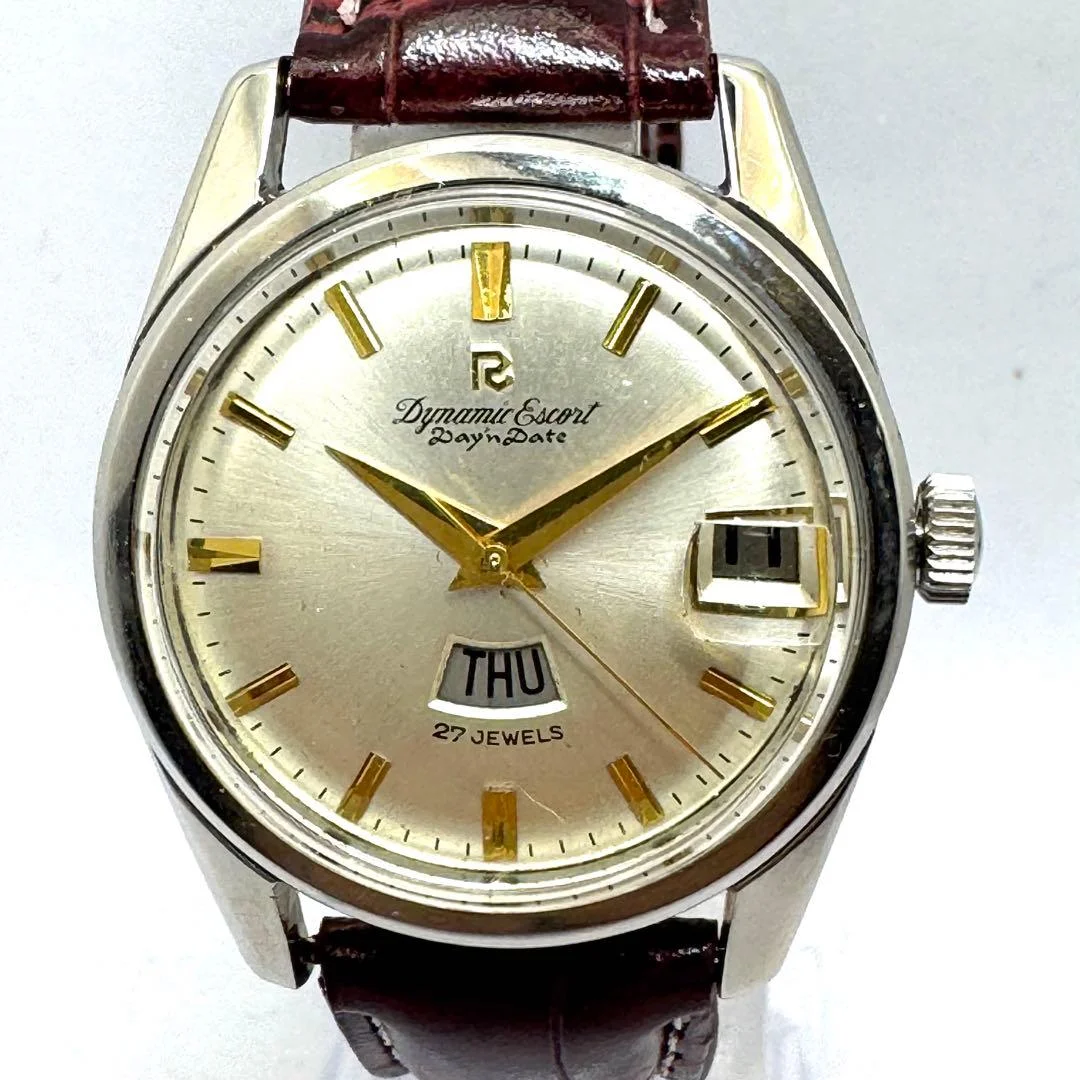
The Ricoh Dynamic Escort Day 'n Date watch was first introduced in Japan in October 1962, offering a choice between a hand-wound square or round design (with the former being particularly rare). During the industrial boom of the 1960s, there was a notable shift in people's mindset towards wearing stylish wristwatches as a fashionable "Escort" or companion.
The term "Dynamic" likely alludes to the innovative date function located at 12 o'clock and the day indication at 6 o'clock. Additionally, the watch boasted a movement featuring 27 jewels, which served to minimize friction and wear, marking a significant advancement during that era.
Released: October 1962 (Shōwa 37)
Jewels: 27
Display: Date at 12 o'clock · Day at 6 o'clock
Case options: Round and square (square particularly rare)
Wind: Manual
Ricoh Dynamic Escort — Calendar 1963

A year after the Day 'n Date, Ricoh broadened the Escort into a whole family of calendar movements — no-date, date-only and day-date, in 23- and 27-jewel spec, sharing parts and interchangeable shock protection. This is the date-only "Calendar": Caliber 644, hand-wound, 23 jewels, with KIF-210 Trior shock protection, the precursor to the MonoRex system Ricoh used on the later Dynamic Wide.
This is the scarce member of the family. The plain no-date Escort and the 27-jewel "Day'n Date" turn up fairly regularly; the hand-wound, date-only, 23-jewel "Calendar" in a gold-plated case is the one collectors rarely see offered. When this listing went up there was no comparable example for sale anywhere online — the last two we could trace were dealer pieces asking roughly €850–950.
The gold-plated case (ref.6506) sits over a stainless steel back, and the silver-white sunburst dial carries the applied R badge above "Dynamic Escort · Calendar" in script, with the date window at three. That dial is the highlight — genuinely top-notch: bright and sparkling, with no specks, spotting or blemishes anywhere and all the printing crisp. This example runs well and appears to have been overhauled by a Japanese watchmaker — a service date is pencilled inside the case back — reading +7 s/d on the timegrapher, with roughly a 36-hour power reserve from a full wind. The gold plating has worn a little on the bezel and the lugs, honest wear for a sixty-year-old gold-plated case; the rest holds its colour well.
Released: circa September–October 1963 (Shōwa 38)
Caliber: 644 · hand-wound · date only
Jewels: 23
Shock protection: KIF-210 Trior
Display: Date at 3 o'clock
Case: Gold-plated · stainless steel back · ref.6506
Dial: Silver-white sunburst · applied R badge · "Dynamic Escort · Calendar" script · excellent, unmarked
Ricoh Dynamic Auto — 45 Jewels 1963

The Ricoh Dynamic Auto 45 Jewels is the pinnacle of Ricoh's 1960s watchmaking ambition — the winner of the so-called "Jewel Wars." Starting from the 33-jewel Cal.54710 base, Ricoh engineers added a 12-jewel ruby ball-bearing system to the rotor shaft, bringing the total to 45 jewels and designating the movement Cal.54722. In 1963 no other Japanese manufacturer could match this count.
The Dynamic Auto series was Ricoh's flagship line following the acquisition of Takano Seimitsu Kogyo, and the 45-jewel variant was their most prestigious statement. The KIF-Flector shock protection system — considered a luxury specification at the time — was later rebranded as "Auto-Just." The silver sunburst dial carries Ricoh's signature "R Dynamic Auto" italic script and is prominently stamped "45 Jewels Waterproof." Date display sits at 3 o'clock. The stainless steel case is paired with the original Ricoh bracelet featuring an embossed "R" deployant clasp — increasingly rare to find intact after 60 years.
Released: 1963 (Shōwa 38)
Caliber: 54722 (Cal.54710 base + 12-jewel ruby ball-bearing module)
Jewels: 45
Shock protection: KIF-Flector
Display: Date at 3 o'clock
Dial: Silver sunburst · "R Dynamic Auto" italic script
Case: Stainless Steel · Waterproof · Original "R" deployant bracelet
Ricoh Automat — First In-House Automatic Movement
Ricoh — you know them for cameras and copiers. But in 1963, they built something extraordinary. This is the Ricoh Automat, the company's first fully in-house automatic movement — not a borrowed caliber, not a modified base, but built from scratch. Caliber 1216, 21 jewels, just 6.4mm thin.
From our archive — a Ricoh Automat we've had the pleasure of selling
Ricoh Auto Deluxe 8 — Cal. 1218
The "Deluxe 8" was released around early 1965 (Showa 40), at roughly the same time as the "Auto-Just," and was positioned as an entry-level model aimed at younger buyers.
Ricoh Dynamic Wide — Ref. 30804, the First "Dynamic Wide"

Released nationwide on 14 February 1966 and shown at Ricoh's month-long exhibition at the San-ai Dream Center in Ginza, the Dynamic Wide became the company's biggest success — Ricoh went on to build its entire automatic production around this caliber 31 family for the next twenty years. Ref. 30804 is the very first version: 25 jewels, Epsilon-train automatic, pull-change quick-set date, fluted bezel and an applied crest under twelve — "the poor man's Rolex," aimed squarely at the Rolex Day-Date. Serviced in Japan (no receipt) and running strongly on the timegrapher.
From our archive — a Ricoh Dynamic Wide Special we've had the pleasure of selling
Ricoh Dynamic Wide Special 49 — Ref. 49801, The Final "Special"
Among the rarest references in Ricoh's celebrated Dynamic Wide series — so rare that Toshiki Mori's standard reference work on Takano and Ricoh (Tombo Publishing) notes that no period sales documentation for this model has ever been found. This exact reference, 49801, is illustrated on page 157 of the book.
Ricoh Ribaron DII — Faceted 9-Sided Crystal
The range-topping model of Ricoh's Ribaron line, introduced October 1970 — the only entry in the series with a seconds-hacking movement, a push-button quick-set date, and an original faceted 9-sided crystal. Caliber 74, 26 jewels.