

Two nicknames, two watches, and about a factor of twenty in price.
The first belongs to the Rolex Day-Date — "the President's Watch." Launched in 1956, it was the first wristwatch to spell out the day of the week in full, in an arched window at twelve o'clock, with the date at three under the Cyclops. Rolex built it in precious metal only — gold or platinum, never steel — hung it on the President bracelet, and it became the watch of heads of state and boardrooms.
The second belongs to the Ricoh Dynamic Wide — "the poor man's Rolex." Day at twelve, spelled out. Date at three. Fluted bezel. In February 1966 you could buy one in Japan for ¥11,000 in steel — or ¥13,500 in gold plate, which was the more expensive of the two, because the gold was the point.
The likeness is not in dispute. What is worth disputing is the word poor, and the assumption that a resemblance this exact must be theft. It isn't. It has a name, and the name is Sue.
I have both ends of this story on the bench: the first Dynamic Wide of 1966, ref. 30804, and the last Dynamic Wide Special of 1968, ref. 49801. Between them is the whole argument.
Ginza, March 1966
On 9 March 1966, Ricoh opened a new-product exhibition at the San-ai Dream Center in Ginza, Tokyo. It ran for a full month. Toshiki Mori's standard reference on Takano and Ricoh calls it without precedent in the industry — a genuinely unheard-of exhibition.
The star was the Dynamic Wide 25 Jewels, released nationwide three weeks earlier, on 14 February. Mori's phrasing is blunt: the company staked its future on this one event. It worked. Ricoh then consolidated its entire automatic production into the "30 series," with the caliber 31 as its ancestor, and kept building on that base for the next twenty years.
Everything below comes out of that month.
The watchmaker who came from Rolex service
The Dynamic Wide was developed by a watchmaker on Ricoh's staff named Sue (末和海; the Japanese sources call him 末氏 throughout, Mr. Sue) whose background was in Rolex service work — years inside Rolex movements, stripping and rebuilding them, learning what makes them good from the only vantage point that really teaches you: the repair bench.
He took the project on after a failure. Ricoh's previous automatic, the AutoJust, had gone badly — and note the name, which tells you where the company's eyes already were. According to Japanese collector accounts drawing on Sue's own autobiography, he answered the failure by starting from nothing, drawing every plate himself, sheet by sheet, and building the movement from the ground up.
What came out is more original than the dial suggests.
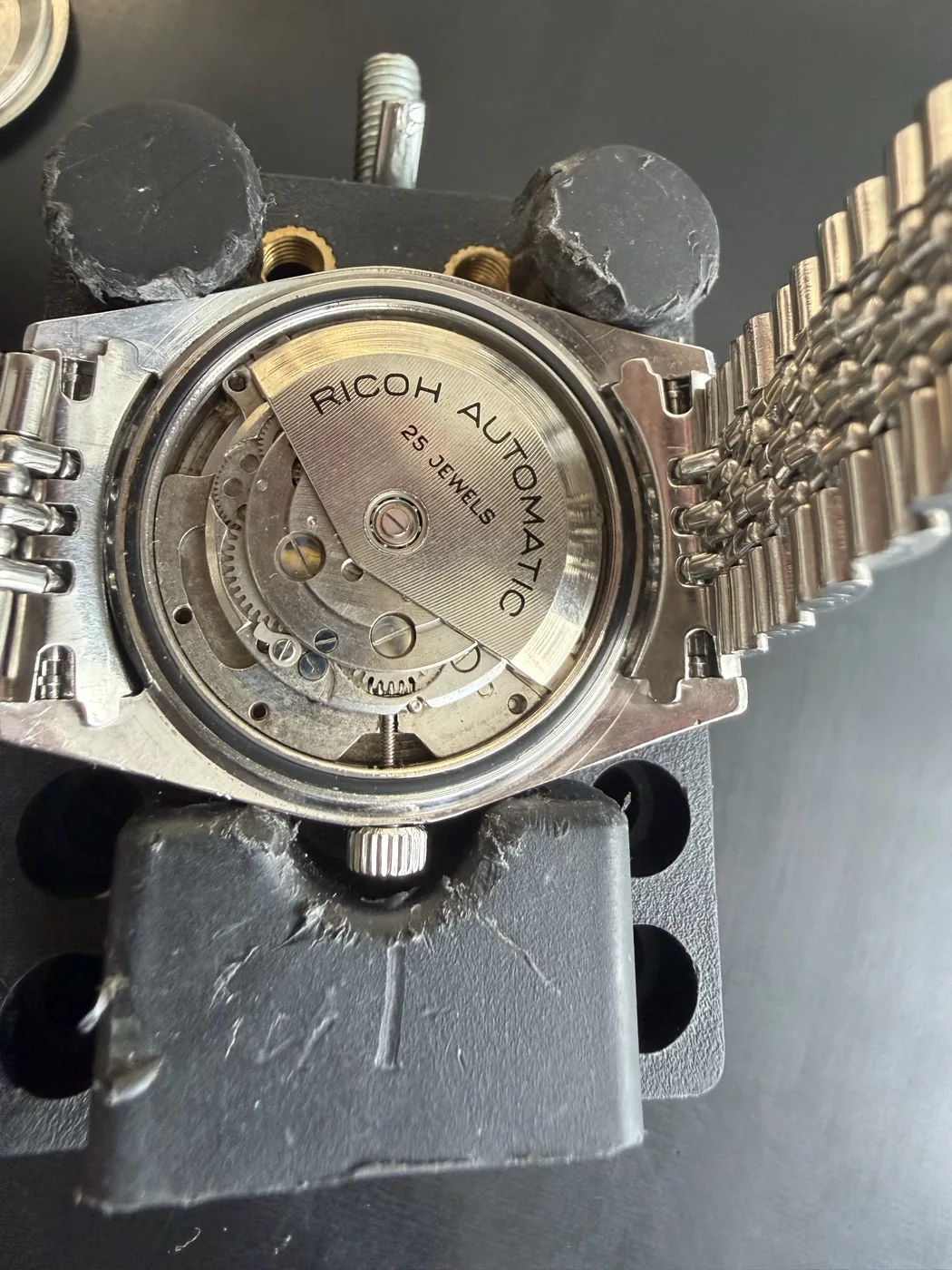
The base train of the caliber 31 arranges the balance, escape wheel and gear train in the shape of the Greek letter ε — Ricoh's own technical notes call it the Epsilon system — producing a true centre-seconds construction. The reason was practical: the layout was contrived to make room for a large-diameter balance, ø9.8 mm, which is big for an automatic. There is a single banking pin riding in a hole bored through the pallet fork. Automatic winding is bidirectional through a floating guide plate carrying two winding wheels, so the rotor winds whichever way it swings. Shock protection is Ricoh's own MonoRex.
And then there is the date. The crown pulls to two positions: the first sets the hands, and each time you pull through to the second, the date jumps forward one day. No pusher at two o'clock interrupting the case line. No winding the hands back and forth through midnight — which is precisely what the AutoJust had made you do. Quick-set convenience with the case profile left intact.
That is a Rolex sensibility, executed in a movement Rolex never built.
There is one thing Sue wanted and never got: a genuine midnight-snapping calendar, from the very first model. Management overruled him — after the AutoJust, the company had no appetite for another gamble. It arrived only with the 35-jewel Hi-Deluxe. By then Sue had left Ricoh, at the end of 1967. The Dynamic Wide was his last project there.
The first one: ref. 30804, 1966
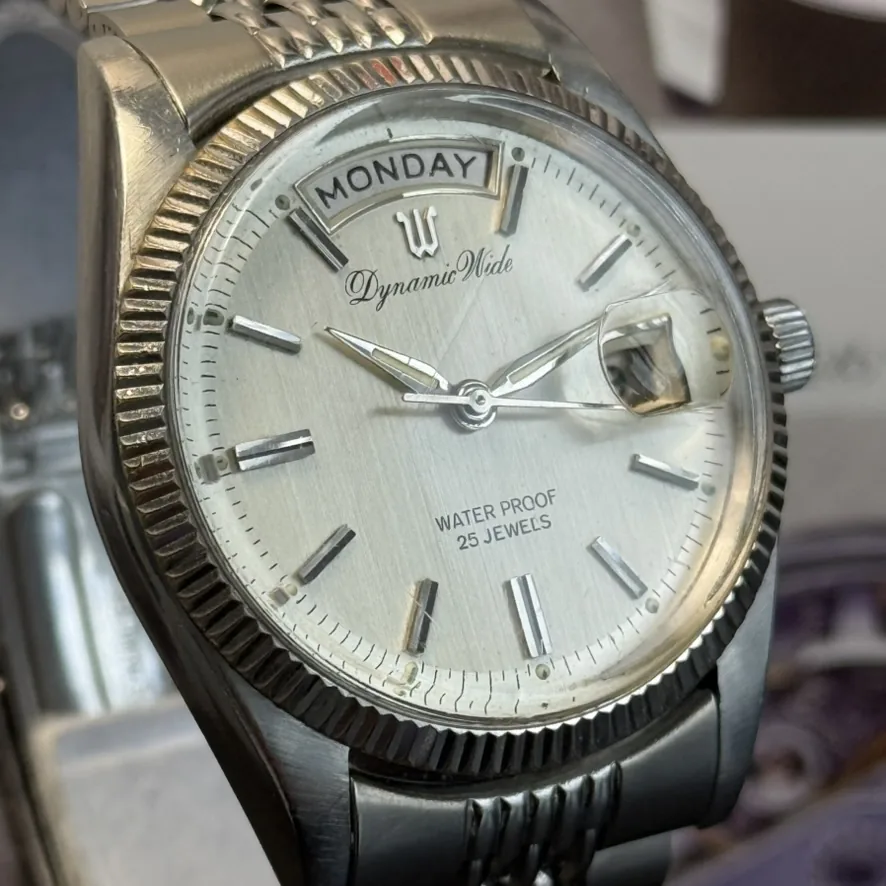
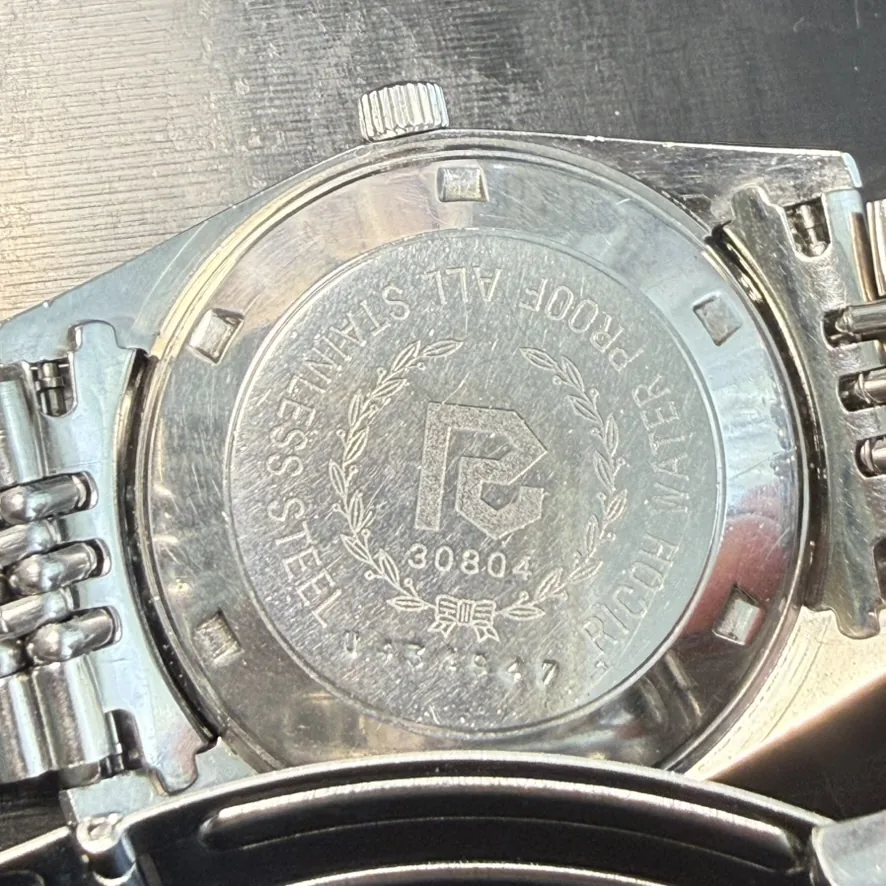
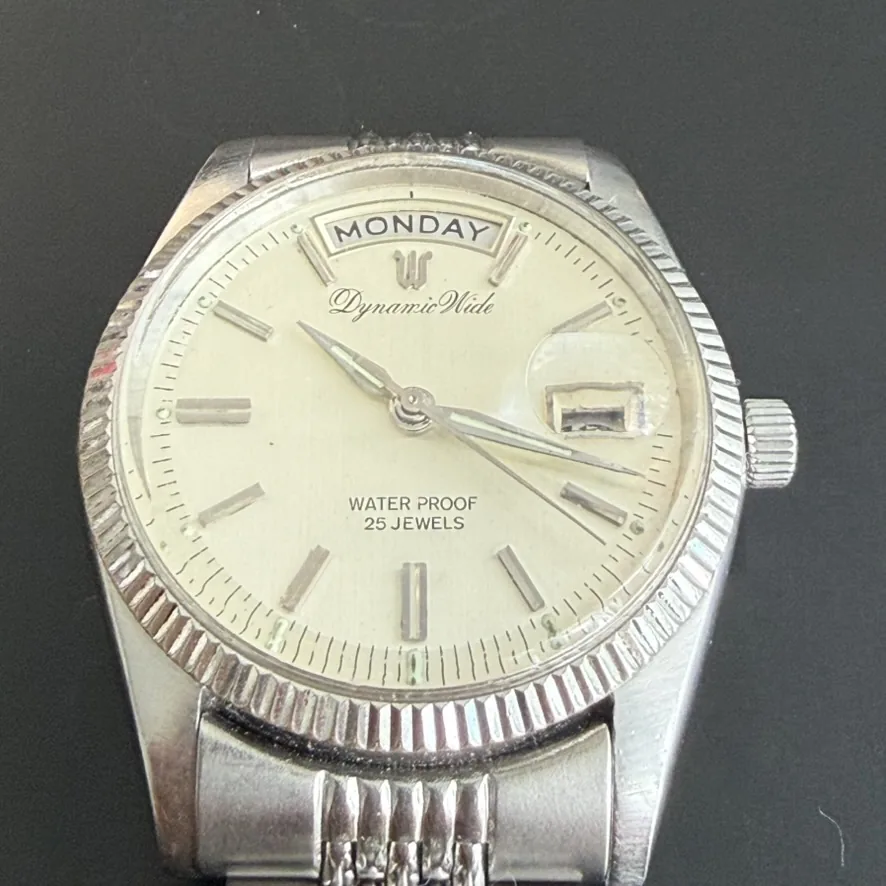
This is the watch from the Ginza room, and it is the most Rolex-shaped object Ricoh ever made.
Day at twelve, spelled out in full. Date at three. Fluted bezel. A screw-back waterproof case of 35–36 mm, and a crown stamped with an R. The caseback reads RICOH WATER PROOF, G.P., STAINLESS BACK — gold plate over the case, steel behind it — and carries the reference 30804. Mori illustrates that exact caseback on page 151.
The dial follows his description to the letter: the applied W beneath the day window, and under it the model's pet name, Dynamic Wide, in its own script. Twenty-five jewels, printed above six with WATER PROOF.
And one detail that no Rolex has: Sunday prints in red. Japanese calendars mark Sundays and holidays in red, and the day wheel simply follows the convention of the country it was made in. On the most Swiss-looking watch Ricoh ever built, the giveaway is a colour. Mori notes that the '12 o'clock day, 3 o'clock date' arrangement was carried straight over from the AutoJust — so the layout is inherited within Ricoh rather than lifted fresh, though everyone involved knew perfectly well where the idea had started.
The caseback number decodes cleanly: 30 for the series, 8 for day-and-date equipped, and the final digits for the case type. (Mori flags one oddity — for the caliber 31 alone, the caliber number and the first two digits of the reference don't agree.)
Jewel counts were 25 and 28. The 25 is 21 in the base train plus 4 in the automatic works. The 28 replaces the rotor-axis bearing arrangement with seven jewels — and Mori records that only a handful of 28-jewel examples have ever been confirmed.
Prices, standard retail:
| 25 jewels, GP, metal bracelet | ¥13,500 |
| 25 jewels, SS, metal bracelet | ¥11,000 |
| 28 jewels, SS | ¥12,000 (estimated) |
| ファセット付 — cut bezel | +¥1,000 |
That last line is worth pausing on. Mori's term is ファセット付 — "with facet" — and it appears in his paragraph on case construction, not on crystals, alongside the note that cases came in GP and SS. The example he photographs under that caption is a gold-plated watch with a cut, fluted bezel. So the fluting was not standard issue. It was a paid option, and the watch on this page is the version that took it.
Which means the specification in front of me — gold plate, cut bezel, metal bracelet — retailed at ¥14,500.
Read that against the other watch in this article. The Dynamic Wide Special of 1968, thirty jewels, top of the range, sold for ¥14,000.
The homage cost more than the original.
Not the Rolex, obviously — a Day-Date was a different order of money entirely, and was never offered in steel at all. Rolex had made the metal itself the barrier to entry: gold or platinum, no other option, ever. That was the whole architecture of the model's exclusivity, and Ricoh's answer was twenty microns of the stuff over brass. Same colour at three feet, same fluted bezel catching the same light, for a sum a Japanese salaryman could actually reach.
But within Ricoh's own catalogue, the two upcharges that made this watch look like a Rolex — the plating and the fluting, ¥3,500 over a plain steel one — cost more than every genuine advance Sue's team made in the two years afterwards. The customer paid for the resemblance. It is the same trick as the badge under twelve, run again in metal: take the silhouette, leave the substance.
The W at twelve o'clock
Both watches wear a small crest directly beneath twelve, above the brand name — exactly where Rolex puts its coronet. People assume it's a borrowed crown. It isn't, and now we can settle it from the literature rather than by inference.
Mori states it plainly: below the day window at twelve, the initial letter of "Wide" is applied to the dial, with the model's pet name printed beneath it in a distinctive script. The factory packaging agrees — the hangtag reads RICOH DYNAMIC WIDE with the W logo under it, and the presentation box lid is embossed RICOH WIDE with the same mark.
Where the model changes, the badge changes. On the Dynamic Wide Eight, the W is replaced by an "8", marking a watch carrying day and date. Wide Deluxe casebacks carry both a W and a DX. It is a family crest with a coding system behind it.
Rolex's mark is the coronet — a five-pointed crown, registered and vigorously defended. It is not a W.
But put the two dials side by side and nobody's first reaction is those are different symbols. They are the same size, in the same place, in the same relationship to the brand name. And this is where the story gets interesting, because the constraint Ricoh was working under was narrower than people assume.
Trademark protects the mark, not the position. Nothing prevented Ricoh from placing a badge under twelve o'clock — that spot was free, and half the industry used it. What Ricoh could not do was put a crown there. The emblem was protected; the layout was not.
So look at how the W is drawn. Three points rising off a base bar, set inside a shield. It is unambiguously a letter, it is documented as the initial of Wide, it appears on the box, the hangtag and the caseback, and it becomes an "8" on the Wide Eight. Completely, defensibly Ricoh's own.
It also, at arm's length, reads as a crown.
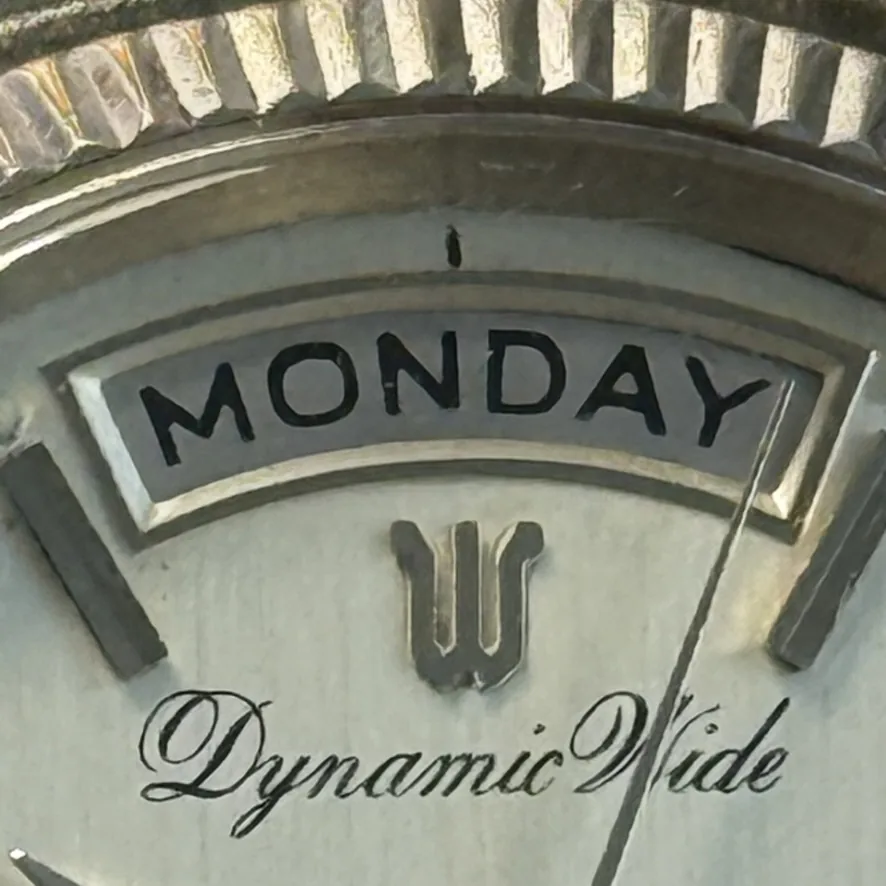
And over the life of the line, it climbs.
On the 1966 watch the order runs: day window at the top, hard under twelve; W beneath it; then Dynamic Wide in script. The badge is the second thing on the dial, subordinate to the calendar. Mori describes exactly this — below the day window, the initial of Wide is applied, and under that the pet name.
By 1968 the two have traded places. On the Special the W sits at the top, directly under twelve, with RICOH below it and the day window below that. Mori has a term for it: the "new type" W badge.
Which puts the crest, on the later dial, in precisely the spot Rolex reserves for the coronet — topmost, centred, above the brand name, with everything else arranged beneath it. On the earlier watch it had been one step down, with the day window occupying the position of honour.
Nobody recorded why the layout was revised, and there is a perfectly dull explanation available: the Special's day window had to move down anyway to make room for a bilingual English-and-kanji wheel, which is wider than a spelled-out English one. The badge may simply have filled the gap left behind.
But the effect is the effect. The watch that borrowed the least from Rolex — the one that moved the date to six and put kanji on the dial — is also the one whose crest ended up standing exactly where the crown stands.
Whether that was deliberate or a happy accident, nothing in the surviving record answers — Mori doesn't raise the question, and no Ricoh design memo on the subject is known. What can be said is that Ricoh found a mark that was legitimately theirs and happened to occupy the same silhouette as the one thing they weren't allowed to use. Make of that what you like.
What Ricoh borrowed, then, was not a symbol but a piece of grammar: a small applied crest, centred under twelve, above the brand name, like a coat of arms. That arrangement was Rolex's, and Sue would have known it better than almost anyone in Japan.
A copy takes the symbol. Sue took the grammar and wrote his own sentence in it.
The copy question, handled straight
There is no point pretending otherwise: this dial is aimed at a Rolex, and Ricoh knew exactly what it was doing. The usual explanation offered is cultural — that copying is simply how Japan did things, and how somebody else does things now.
The explanation doesn't survive the comparison.
Early Swiss makers built copies of English watches, sometimes down to counterfeit London signatures. Samuel Slater carried British textile machinery into America in 1789 the only way he could — memorised, in his head, because exporting the plans was illegal. "Made in Germany" began life as a warning label: Britain's Merchandise Marks Act of 1887 required imported goods to be marked with their origin, specifically so buyers could avoid inferior German imitations. It took about thirty years for that label to mean the opposite.
Every one of those industries copied at the same stage of development, and every one of them stopped when it could compete instead. Japan's version of that phase ran roughly fifteen years and ended in December 1969, when Seiko put the Astron — the world's first quartz wristwatch — on sale ahead of Switzerland. It is difficult to argue for a cultural predisposition to imitate on the part of the country that got there first.
And the Dynamic Wide makes the point better than any of them, because both halves are in the same watch, from the same year, out of the same building. The dial copies a Rolex. The movement underneath it — the ε-shaped train, the oversized balance it was contrived to accommodate, the pull-change quick-set nobody else was using — copies nothing at all.
That is what catching up actually looks like from the inside. Borrow the face, because the face is what sells it. Build the guts yourself, because that is the part you are trying to learn.
The last one: where it stops being a homage
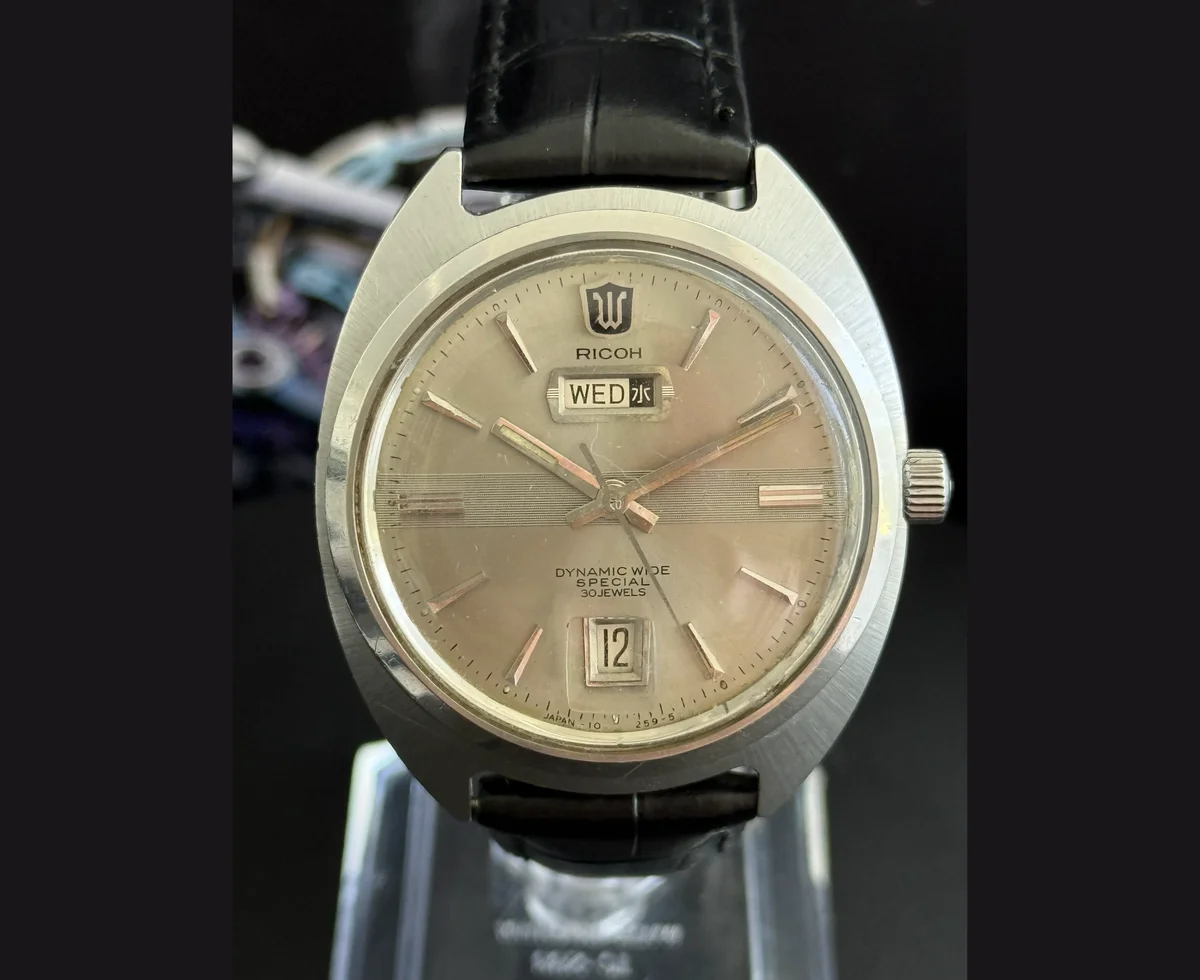
Two years later, at the other end of the line, the Special breaks the pattern.
Day still at twelve — but now bilingual, English and kanji side by side. And the date has moved down to six o'clock.
Rolex never made that watch. Not in the Day-Date, not in the Datejust, not anywhere. At that point the Special is nobody's copy.
And look at what the move buys.
The defining feature of this dial is the striped line-finish running horizontally across the centre, from nine to three, laid over a radial hairline ground. It is the whole character of the watch — a band of ruled lines cutting through a sunburst, restrained to the point of severity.
Now put a date window at three, where the Day-Date and every other Dynamic Wide puts it. The aperture lands directly in the path of that band and cuts it off short of the index. The dial's one architectural gesture is broken by a hole.
At six o'clock, the band runs edge to edge, unbroken.
Whether the dial was drawn to suit the calendar layout or the layout chosen to free the dial, Mori does not say, and no other documentation survives to settle it — and this late type appeared roughly a year after Sue had left, so the hand that combined the two may not have been his, though the Special specification and the movement family are.
But the effect is not in doubt. This is the one Dynamic Wide whose dial only works because the date isn't at three.
The Special itself

Mori illustrates this exact reference — 49801 — on page 157, and records something remarkable: apart from a single entry in the Automatic Winding Technical Notes table, no period documentation for this model can be found at all. No catalogue page, no release announcement, nothing. It is believed to be a one-off release from around the end of 1968, the final evolution of the Special specification.
His dial description matches the watch in hand exactly: the "new type" W badge at twelve with the day window below it in a rectangular decorative frame; the date window above six, with the jewel count and Special printed modestly alongside; radial hairline crossed by the striped line-finish from nine to three. He calls it an unusual dial with a calm, restrained atmosphere, and believes the treatment was exclusive to this final type.
Movement finishing is at the same careful level as the other calibers — jewel count and placement unchanged, date correction by the same pull-change crown Sue had designed in 1966, single-piece rotor in the Special tradition.
Original retail: ¥14,000, the top of Ricoh's range — against ¥11,000 for the steel 25-jewel first model two years earlier.
At 37.8 mm in stainless steel with a screw-back case, it wears startlingly modern for a watch approaching sixty.
Both nicknames, revisited
"The President's Watch" was gold or platinum and nothing else. That was the point of it — and Ricoh answered it with gold plate over brass and a straight face. Sixty years on, the plating on this one has worn thin at the lugs and along the bracelet, and the base metal shows through in patches. Which is, if you like, the honest ending to that particular argument: the gold was always a few microns deep. The movement underneath it was not.
"The poor man's Rolex" is accurate about exactly one thing — the price — and wrong about everything else. A Japanese collector put it better than I can: given that Sue came out of Rolex service and understood Rolex's virtues better than anyone, the family likeness is not imitation but inheritance. This is not a copy or an homage. It is a real watch, built in earnest by one of the finest watchmakers Japan had at the time.
He never got his snapping calendar. He was gone from the company within two years. And he left behind an ε-shaped train drawn plate by plate, a quick-set nobody else was using, a movement family that ran for two decades — and, at the end of the line, a dial layout the company he learned from never thought to build.
Not a poor man's anything. Just a very good watch that nobody wrote down.
That factor of twenty has not aged well for Ricoh, either. A Rolex Day-Date from this period now sells at auction for something in the region of €11,000. A Dynamic Wide in comparable condition trades for closer to €600. What was a twenty-to-one gap in 1966 is closer to twenty-to-one still today, but on a much larger scale — the name outran the watch by a much wider margin than the watch ever trailed the name.
The two watches
| Dynamic Wide, ref. 30804 | Dynamic Wide Special, ref. 49801 | |
|---|---|---|
| Year | 1966 | c. late 1968 |
| Movement | Ricoh cal. 31, Epsilon train, MonoRex | Ricoh cal. 49, single-piece rotor |
| Jewels | 25 | 30 |
| Layout | Day 12 (full spelling), date 3 | Day 12 (English/kanji), date 6 |
| Case | 35–36 mm, gold plate with stainless back, R-marked crown | 37.8 mm stainless steel, screw-back |
| Date setting | Pull-change quick-set | Pull-change quick-set |
| Original retail | ¥14,500 (GP, cut bezel, bracelet) | ¥14,000 |
| Literature | Mori Toshiki, Takano / Ricoh (Tombo), pp. 150–151 | ibid., p. 157 |
Sources: Toshiki Mori, reference work on Takano and Ricoh (Tombo Publishing); Japanese collector accounts drawing on the watchmaker Sue's own autobiography; movement-family data cross-referenced against horological documentation of Ricoh's automatic calibers.