The Beginning
Humble Origins in Tokyo
Citizen's story begins in 1918 when the Shokosha Watch Research Institute was established in Tokyo. This pioneering organisation was the brainchild of Kamekichi Yakamazi, whose vision was to produce reliable, locally made timepieces in a market dominated by imports. By 1924, the institute produced its first pocket watch, named "Citizen" — a name chosen by Count Goto Shinpei, Tokyo's mayor, symbolising the brand's aim to create accessible timepieces for everyone.
In 1930, Yosaburo Nakajima officially established Citizen Watch Co., Ltd., spearheading efforts to modernise production and foster innovation that would lay the groundwork for Citizen's eventual international success.
Citizen C Parashock — A National Sensation
The rapid industrialisation of Japan after WWII led to the Citizen C (centre seconds) in 1956 — a wristwatch for the general public that could compete with Swiss watches but at a much lower price level. Handwound with three small golden hands and a stainless steel case, it was the first Citizen equipped with a central sweeping hand rather than the usual eccentric seconds.
One of its most important features was the Parashock shock-resistance system — comparable to Seiko's Diashock. During the summer of 1956, Citizen staged public demonstrations in 11 different cities. In Osaka, the Parashock watch was dropped from a helicopter 30 meters above the ground before a large crowd. The watch was not damaged upon impact. The same experiment was held countrywide — an extraordinary marketing moment in Japanese horological history.
Citizen Auto — First Automatic
The first automatic wristwatch by Citizen was produced in 1958, lasting only three years before being superseded by the rotor-based Jet family. Citizen pushed ahead of Seiko — the Citizen Auto featured bi-directional winding a full year ahead of Seiko's Gyro Marvel, and was competitively priced.
Citizen Super Deluxe
Introduced in 1958, the Super Deluxe was the best Citizen watch on the market — an upgraded version of the Deluxe with movements 9200, 9201 and 9202 with 23 and 25 jewels, adjusted in more than 3 positions. Very successful with over 100 million Yen in sales over its production period. The PHYN OX mainspring — marketed as "unbreakable" — addressed common breakage issues of earlier carbon-steel mainsprings.
Notable example: Stainless steel case with golden indexes and dagger hands in solid 14 carat gold. Retail price ranged from 10,000 to 33,000 JPY depending on configuration — roughly double the price of the regular Deluxe, competing directly with Seiko's Crown Special.
From our archive — a Citizen Super Deluxe we've had the pleasure of selling
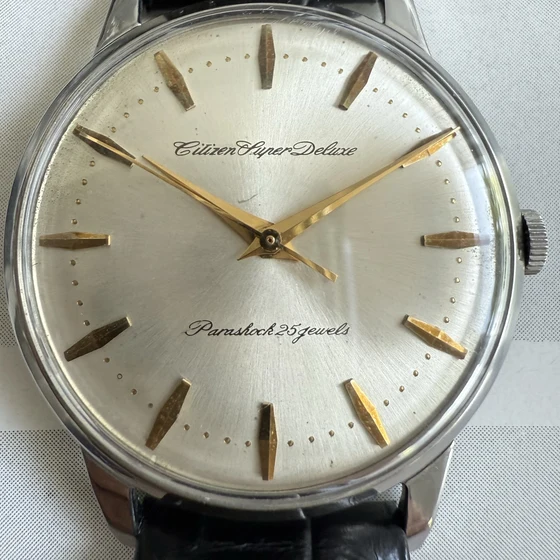
A Citizen Super Deluxe with the cursive "Citizen Super Deluxe" script signed on a brushed silver dial, "Parashock 25 Jewels" printed below the center — the higher jewel-count variant of the line. Stainless steel case, applied gold dagger indices with a full ring of minute dots, and matching gold dagger hands. A clean, formally dressed example of Citizen's flagship 1958–1963 line.
Citizen Homer — The Railway Watch
The Homer second setting was the Japanese railway watch of the 1960s. Handwound with caliber 911 and 21 jewels — extremely reliable. White porcelain coloured dials with black numerals. Later in the 1960s came a few Homer variants — the Guppy, the Special, and featuring red, yellow or green dials — the Pansy.
Citizen Jet Automatic — Born from Aviation
The Jet stands for fascination with aviation and technological innovation. The year 1961 was pivotal in the watch industry with automatic movements and date indication as new technological hallmarks. The first Jet rotor movement 0310 used a circular geared rotor in the early to mid-1960s. Features 18,000 beats per hour, 21–25 jewels. First models carried the cool Jet symbol and are now rare.
Citizen Jet Autodater — The Rarest Series
The Jet Autodater series was introduced in 1962 with Jet movement 1120/1121. Only the first series carried the Jet symbol below 12 o'clock — making this the rarest and most collectable. From 1964 the 7 series arrived with 25 jewels. These were the best automatics Citizen produced — with handwinding capability and the 40m Parawater designation. Available in 19, 21, 23, 27 and 35 jewel variants. The 19-jewel versions also came as 120m and 200m divers.
Coming soon — in transit from Japan
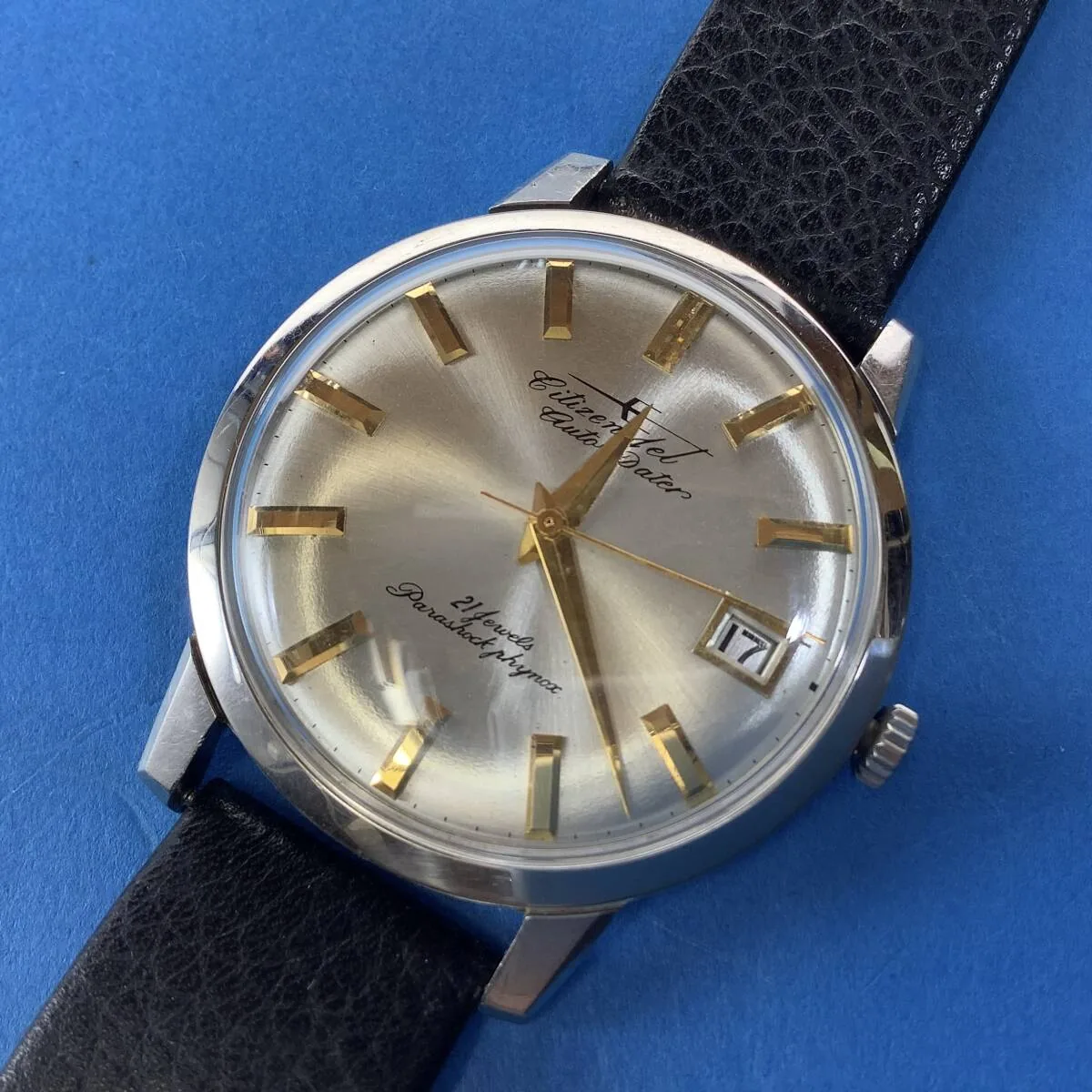
A first-series Citizen Jet Auto Dater with the original Jet symbol below 12, 21 jewels, signed "Parashock Phynox" on a silver sunburst dial with applied gold indices and date at 3 o'clock. The watch is on its way from Japan, and the price will be announced on arrival. Read the full story or see it in the shop.
From our archive — a Citizen Jet AutoDater 7 we've had the pleasure of selling

A New Old Stock Citizen Jet AutoDater 7, powered by the 25-jewel caliber 0141 Jet rotor movement — the pinnacle of the Jet series, known for its unique ring-shaped rotor. Stainless steel 40mm case with a sunburst silver day/date dial, rated to 40 meters under the "Parawater" designation. An exceptionally rare find in this condition.
Citizen Super Jet — As Expensive as a Rolex
The first Citizen Super Jet automatic (no date, 35 jewels, caliber 0340/0341) was introduced in 1963. The Super Jet Autodater with 39 jewels (caliber 1150) followed that same year. These were the highest graded watches Citizen produced — and they cost the same as a Rolex at the time. Running at 18,000 bph with a power reserve of 45 hours and handwinding possible.
Super Jet 39 Jewels: Adorned with the iconic rocket emblem and the three-stars logo reserved for Citizen's most upscale offerings. Gold-filled case at 100 microns — higher quality than the 80 microns of the Super Deluxe. Stainless steel versions were also available.
From our archive — a Citizen Super Jet we've had the pleasure of selling
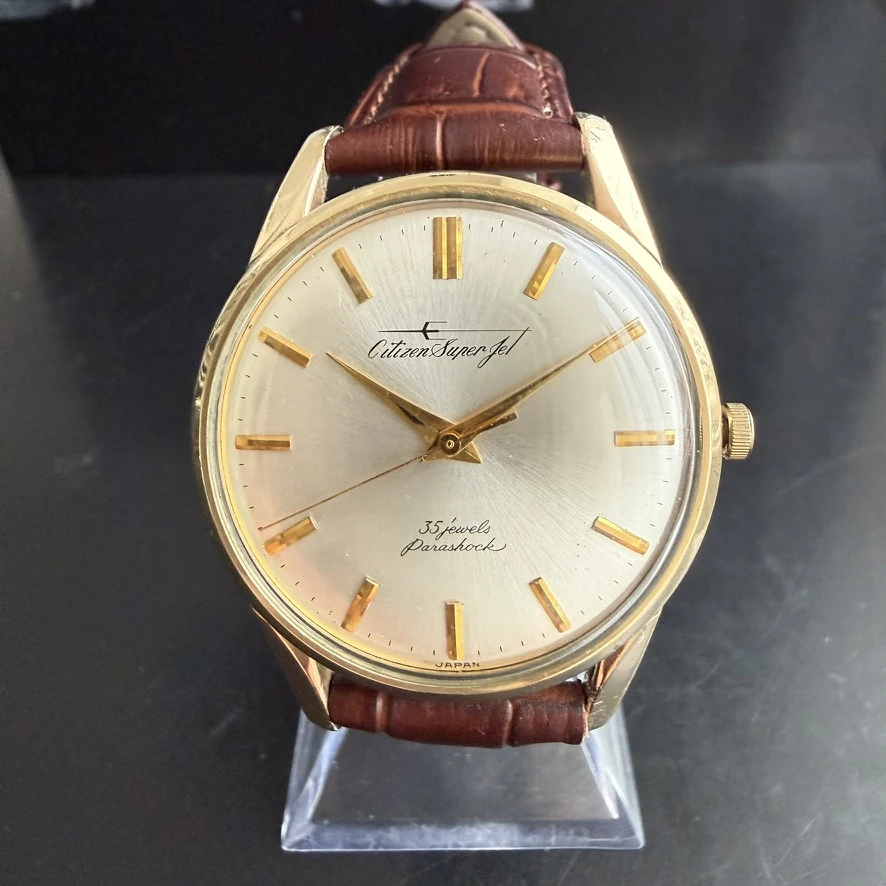
A Citizen Super Jet with the cursive "Citizen Super Jet" script signed on a silver dial, "35 Jewels Parashock" printed below the center — the no-date 35-jewel variant, caliber 0340/0341. Gold-filled case with applied gold baton indices and matching gold dagger hands, paired with a brown leather strap. Among the highest-graded automatics Citizen produced, priced on par with a Rolex when new.
Citizen Diamond Flake — Ultra-Thin Pioneer
The Citizen Diamond Flake, introduced in 1964, gained fame as one of the thinnest mechanical watches ever made — just 2.75mm for the case. The Caliber 2700 (FD) measured just 2.73mm thick, an incredible technical feat. It competed directly with the Piaget Altiplano (Caliber 9P at 2mm) and surpassed the Jaeger-LeCoultre Master Thin and Seiko Liner 1019 (3.5mm) in thinness.
Citizen Crystal Seven — Hardened Mineral Glass
The Crystal Seven line introduced hardened mineral glass for the first time — putting "Crystal" in the name. A wide range of models using the 52 movement with variants from 21 up to 43 jewels — Citizen's highest ever jewelling and now a sought-after piece. With a Custom line featuring colourful dials and cushion cases, it was Citizen's main automatic line until 1970.
Coming soon — in transit from Japan
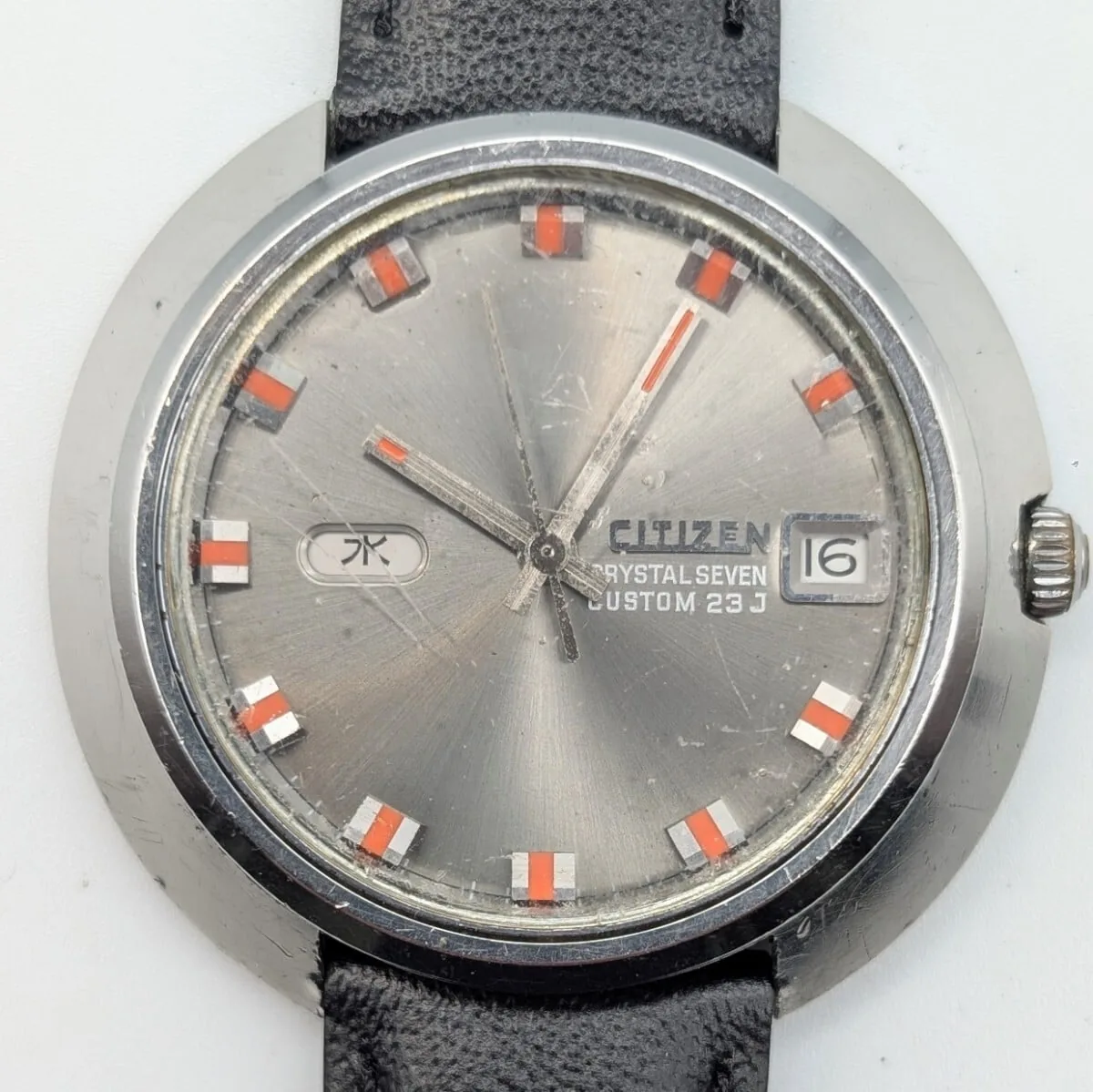
A 1968 Citizen Crystal Seven Custom 23J, Ref. ACSS 2815-Y, with a grey sunburst dial, silver-and-orange indices, day/date and a wide stainless steel "UFO" case. A new crystal will be fitted before sale, and the price will be announced on arrival. Read the full story or see it in the shop.
Citizen Leopard Chronometer
High-accuracy mechanical watches with chronometer certification. Fast-beat movements with 10 vibrations per second (10 bps) — Citizen's answer to the Swiss chronometer trials. Succeeded in the 1970s by the Leopard Hi-Beat with movements at 28,800 bph or higher.
The Disco Era — Bullhead, Seven Star & Super King
Citizen Automatic Diver 150m (1970): Citizen's first professional dive watch — setting a standard for durable functional mechanical dive watches.
Citizen Bullhead Chronograph (1973): Unique "bullhead" design with pushers at the top. Caliber 8110 automatic chronograph movement with 24-hour sub-dial and tachymeter scale.
Citizen Seven Star: Stylish, affordable automatic watches for everyday wear with day/date complications.
Citizen Super King: An evolution of the King series combining robust performance with luxurious styling. Automatic movements with day/date complications. Textured or gradient dials with bold, modern designs.
Citizen Cosmotron — The Electronic Balance Wheel
In 1966 Citizen launched the X8 "Electric Watch", Japan's first electronic wristwatch. In 1969, at the height of the space age, the first Cosmotron followed: "Cosmo" for space, "-tron" for electronics. Instead of a mainspring, a battery and a transistor drive a real balance wheel, and a classic gear train moves the hands. The best versions were certified chronometers, and the 78 series of 1972 added day/date with a balance beating at 36,000 vibrations per hour. The era lasted only about ten years before quartz took over.
History via Sweep Hand — The X8 & Cosmotron.
We specialise in mechanical watches, but we make an exception for these early electronic watches, because their heart is still mechanical.
Coming soon — in transit from Japan
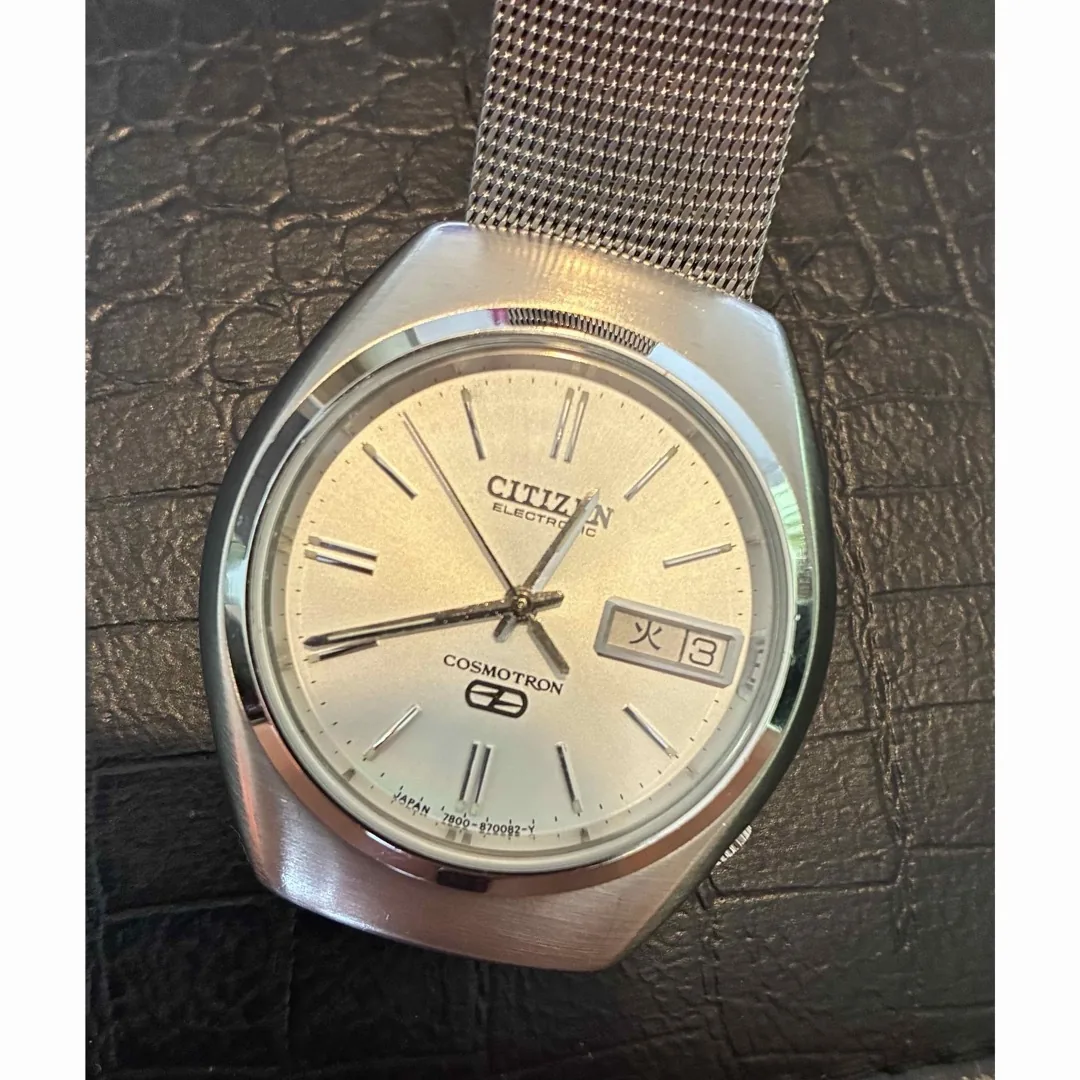
A Citizen Electronic Cosmotron, calibre 7800, with a silver sunburst dial, day/date and its original Citizen mesh bracelet. The price will be announced on arrival. Read the full story or see it in the shop.
Citizen Watches Available Now


From our archive — a Citizen Crystal Seven we've had the pleasure of selling
