The Beginning
How It All Started
In 1901 Shogoro Yoshida founded the "Yoshida Watch Shop" in Ueno, Taito, Tokyo, originally specialising in imported pocket watches. Through war, economic hardship and remarkable reinvention, Orient grew into one of Japan's most respected in-house movement manufacturers — the name itself derived from the Latin "oriri" meaning "to rise."
Yoshida Watch Shop, Ueno, Tokyo
The history of Orient Watch Company dates back to 1901 when Shogoro Yoshida founded the "Yoshida Watch Shop" in Ueno, Taito, Tokyo, originally specialising in imported pocket watches. In 1912 the shop expanded to produce gold wristwatch cases. In 1920, Toyo Tokei Manufacturing was established, focusing on table clocks and gauges. By 1934 the company began manufacturing wristwatches. In 1936 the Hino factory was constructed in Tokyo, marking a period of prosperity — until the company ceased operations in 1949 due to post-war economic hardship.
Rebirth — Orient Watch Company
Following the closure, Yoshida resurrected wristwatch production in 1950 with the establishment of Tama Keiki Company. In 1951 the company rebranded as Orient Watch Company, Limited — coinciding with the launch of the inaugural Orient Star. The very name "Orient" derives from the Latin "oriri" meaning "to rise," epitomising the brand's aspirations for the worldwide market: robust, accurate timepieces featuring premium in-house movements at competitive price points.
Orient sought expertise from Tamotsu Aoki — former Professor at the University of Tokyo and founding chair of the Horological Institute of Japan — who held ambitious plans to revitalise the Japanese watch industry and expand its global presence.
Orient Star — The Pinnacle
The first Orient Star debuted in 1951 — the pinnacle of Orient timepieces, aiming to surpass all other mechanical watches across the universe. The timeless design remains unaltered to this day, exuding class and elegance with its distinctive asymmetrical second hand, blue hands, and the iconic Orient Star logo.
Orient Star Dynamic & Nivaflex
In 1957 Orient introduced the Orient Star Dynamic, featuring a central hand and Nivaflex spring — a tear-resistant material showcasing the brand's commitment to innovation. The Dynamic line featured the new T-type centre seconds movement, partly due to Nivaflex spring technology. Orient experimented with elaborate dial designs to create a more contemporary dress-watch style for the late 1950s.
Royal Orient — The Luxury Line
Continuing its upscale trajectory, Orient launched the Royal Orient in 1958 — water resistant with the brand's larger diameter and more stable 19-jewel N-type movement. In 1961 Orient unveiled the first Royal Orient Calendar models.
Royal Orient Calendar: Case diameter ~37mm, lug-to-lug ~44mm, case thickness 9mm. Caliber N movement, 21 jewels, hand-wound. Showerproof. The slim case creates a larger dial presence than its size suggests. Enthusiasts admire it for its refinement, dependability, and historical significance.
Grand Prix — The Jewel Count Battle
The Grand Prix marked Orient's first steps into high-end timepieces, featuring top-of-the-line mechanical components commanding a premium price. Orient engaged in a "battle of the jewel count" during the early 1960s, resulting in the extraordinary Grand Prix 100 — boasting 100 jewels, featuring the IWC Pellaton automatic winding device, a Triostat for chronometer-level accuracy, and an Incabloc for shock resistance. Cases in 14k white gold-filled with silver as the base metal.
The Grand Prix Almighty 64 stands out as a rare JDM model featuring 64 jewels, commemorating the 1964 Tokyo Olympics.
Orient Olympia — The Tokyo Olympics
The 1964 Tokyo Summer Olympics marked Japan's post-war resurgence. The Orient Olympia Weekly (1963) added day and date functions with a manual-wind 19-jewel movement. The Olympia Calendar Swimmer featured enhanced water resistance with a screw-back case — the "Swimmer" label first used on the Royal Orient Swimmer (1959–60). The first Olympics held in Japan and Asia inspired a generation of watch designs.
Weekly Auto Orient King Diver
In Japan's golden 1960s of explosive growth and cultural change, the Weekly Auto Orient King Diver emerged — 40m water resistance for skin divers, suitable for free diving and light recreational use. Its relatively innovative movement and great looks make it a compelling choice for vintage enthusiasts. Orient reissued it as the King Diver 70th Anniversary in a larger 43.8mm case.
Orient Fineness Ultramatic — World's Thinnest

Having won the jewel-count competition with the Grand Prix 100, Orient shifted focus to the thinnest watch movement. In 1967 Orient introduced Caliber 3900 — just 3.9mm thick, surpassing Citizen's 3.98mm Caliber 54. The new movement featured 35 jewels, bi-directional winding and Incabloc shock absorption.
Orient Fineness Ultramatic: Distinctive cushion case with sharp edges, 33mm wide, ~8.5mm tall including domed crystal. Basic models retailed for just below 20,000 JPY. Citizen reclaimed the record only in 1974 with the 3.73mm Caliber 8001A.
From our archive — a Fineness Ultramatic we've had the pleasure of selling
A rare Roman numeral dial example, Ref. 012402 — read the full story →
The Marilyn Monroe Calendar
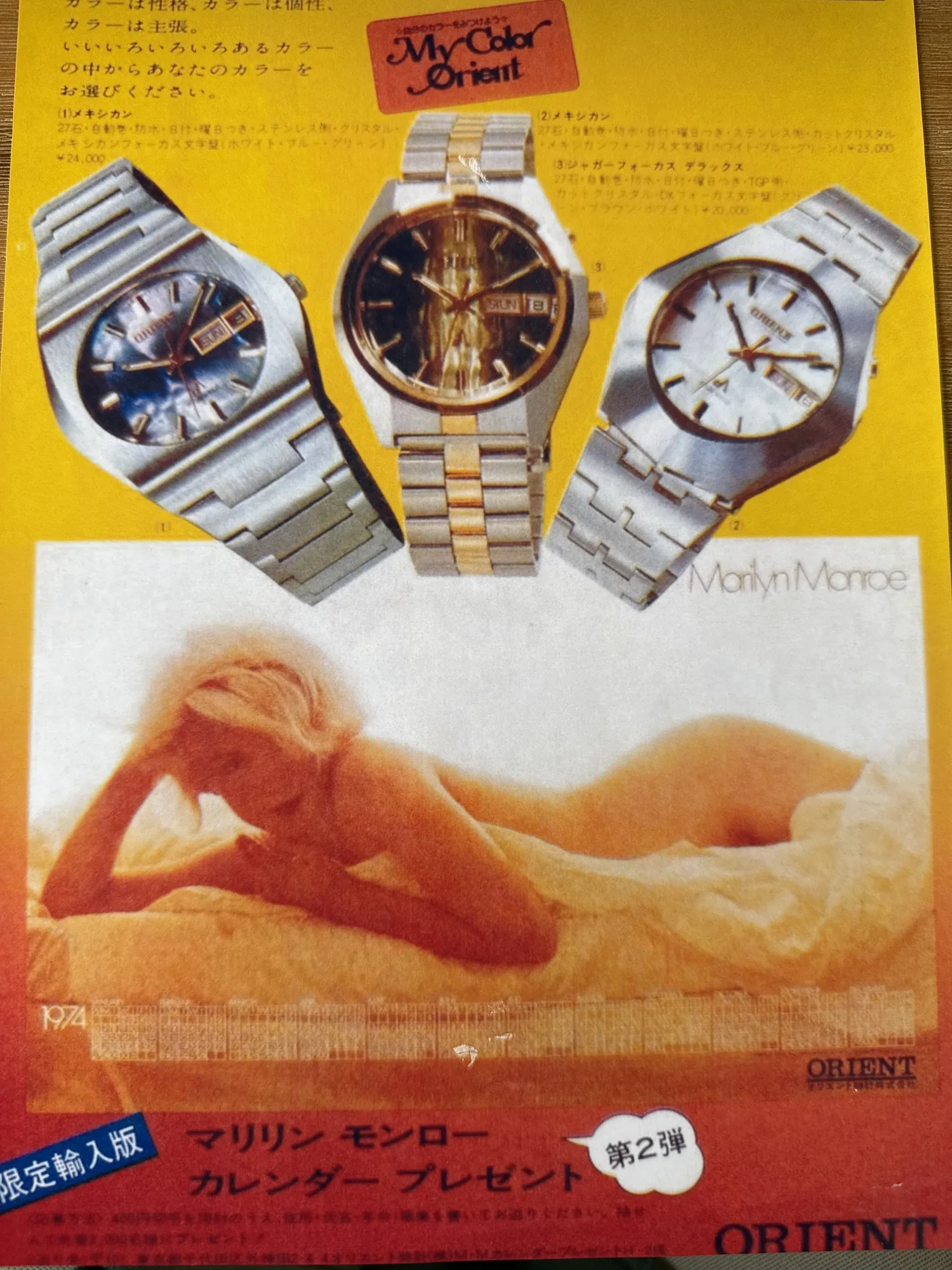
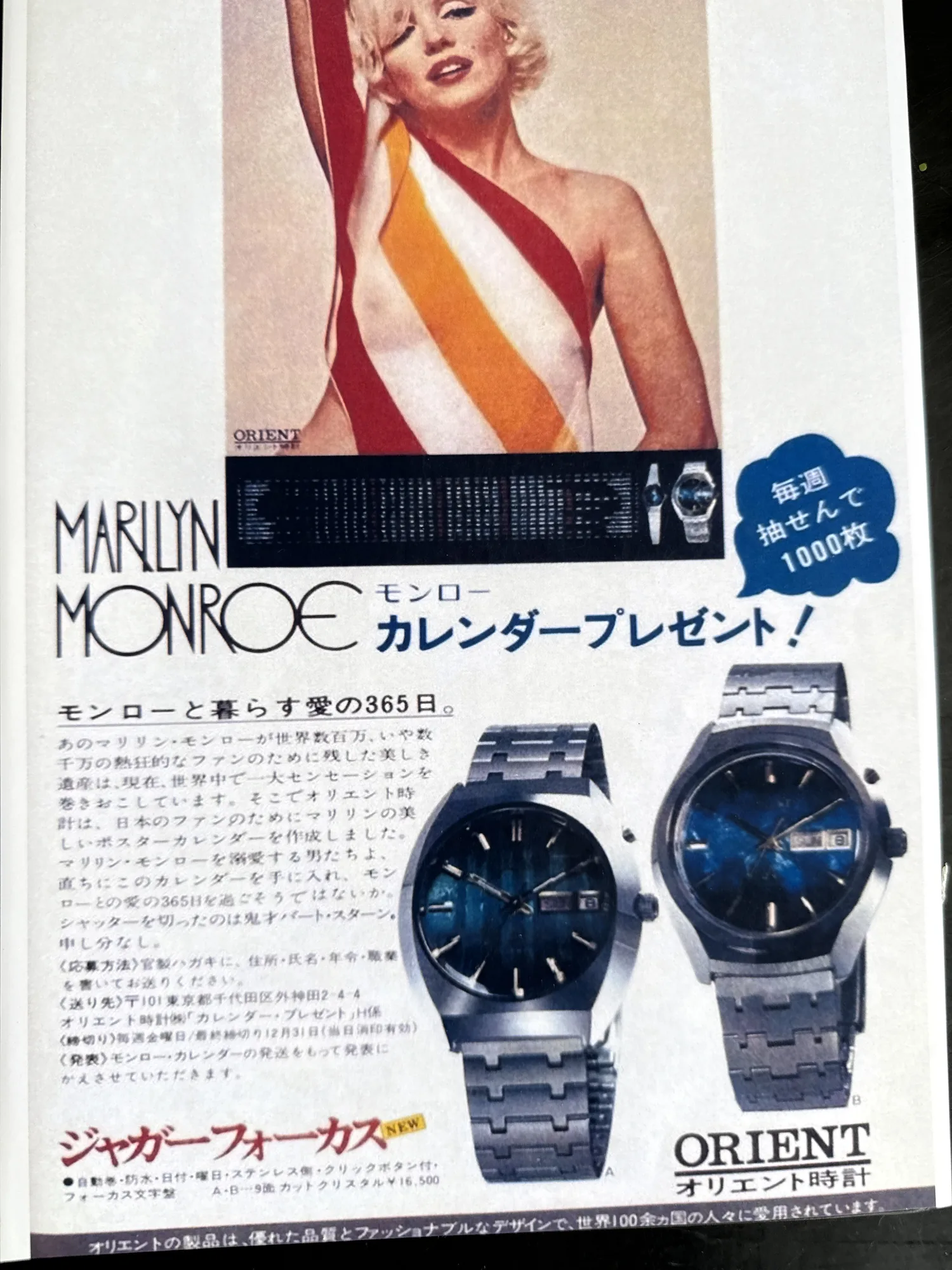
In a fascinating piece of mid-century marketing, Orient offered a Marilyn Monroe calendar as a gift to every purchaser of an Orient watch — the "My Color Orient" campaign. The advertisement read: "Color is personality, color is individuality. Choose your color from a variety of rich and expressive options." A limited import edition Marilyn Monroe calendar was presented with every purchase — a wonderful example of the cultural crossover between American glamour and Japanese precision watchmaking of the 1960s.
Orient HA (High Ace) — Day/Date Automatic
By the early 1970s, Orient was naming its models after the icons of the moment — and few vehicles said "modern and capable" quite like Toyota's Hi-Ace van, launched in 1967 and already a familiar sight on Japanese roads. A few years later, Orient borrowed the name for a new automatic line: the High Ace, styled simply as "Ha" on the dial.
The High Ace sat a step above the everyday Chrono Ace in Orient's lineup, commanding roughly a 20% premium — and the movement justified it. The Cal.46 automatic is a day/date caliber with 21 jewels, part of the same movement family that would go on to form the technical backbone of the early Orient Star line. It's a sturdy, reliable workhorse of a movement, the kind Orient built its reputation on through the 1970s.
This example wears a deep blue dial with applied steel indices, luminous markers, and the day/date window at 3 o'clock — clean, legible, and honestly proportioned, without the excess of some of its flashier contemporaries. Full stainless steel case and bracelet throughout.
Freshly serviced in 2025: on the timegrapher it ran at +13 seconds/day with 239° amplitude and 0.0ms beat error — excellent results for a movement over fifty years old, and a good sign of how carefully these were engineered.
Model: Orient HA (High Ace)
Caliber: 46 (21 jewels, day/date)
Release: c. 1972
Case & bracelet: Stainless steel
Dial: Blue, applied indices, luminous markers
Service: 2025 — +13s/d, 239° amplitude, 0.0ms beat error
Rarity note: the High Ace name was used for only a short run in Orient's catalogue before being superseded by later automatic lines, so clean examples like this one don't turn up often. Import costs and VAT are the buyer's responsibility.
Orient Three Star Automatic — Tonneau, Colour-Change Day Window
Through the 1960s and beyond, Orient marked the grade of its automatic movements with a small row of stars on the dial rather than printing exact caliber or jewel figures — one star for entry-level, up to three (and later five) for the sportier and better-finished tiers. This piece wears its three stars proudly, just below 12 o'clock, signalling a step above Orient's most basic automatics.
The case is a bold tonneau — a squared-off "tank" shape with softened corners — a style that has cycled in and out of fashion since the 1970s and still reads as distinctive today. The dial's stand-out feature is its day-of-week display: instead of a single day/date window, the days are printed in a ring around the dial (MON through SUN), each with its own little indicator window, and a red-highlighted marker slides around to point at the current day as the days turn over — a genuinely fun bit of watchmaking theatre you don't see on most day/date pieces. A conventional date window sits at 3 o'clock alongside it.
Model: Orient Three Star Automatic
Case: Tonneau (tank) shape, stainless steel
Dial: Rotating day-of-week ring with colour-change indicator, date at 3
Water resistance: 50m
Condition: Good running condition
Import costs and VAT are the buyer's responsibility.
Orient World Diver — the Rare “SW” Dial
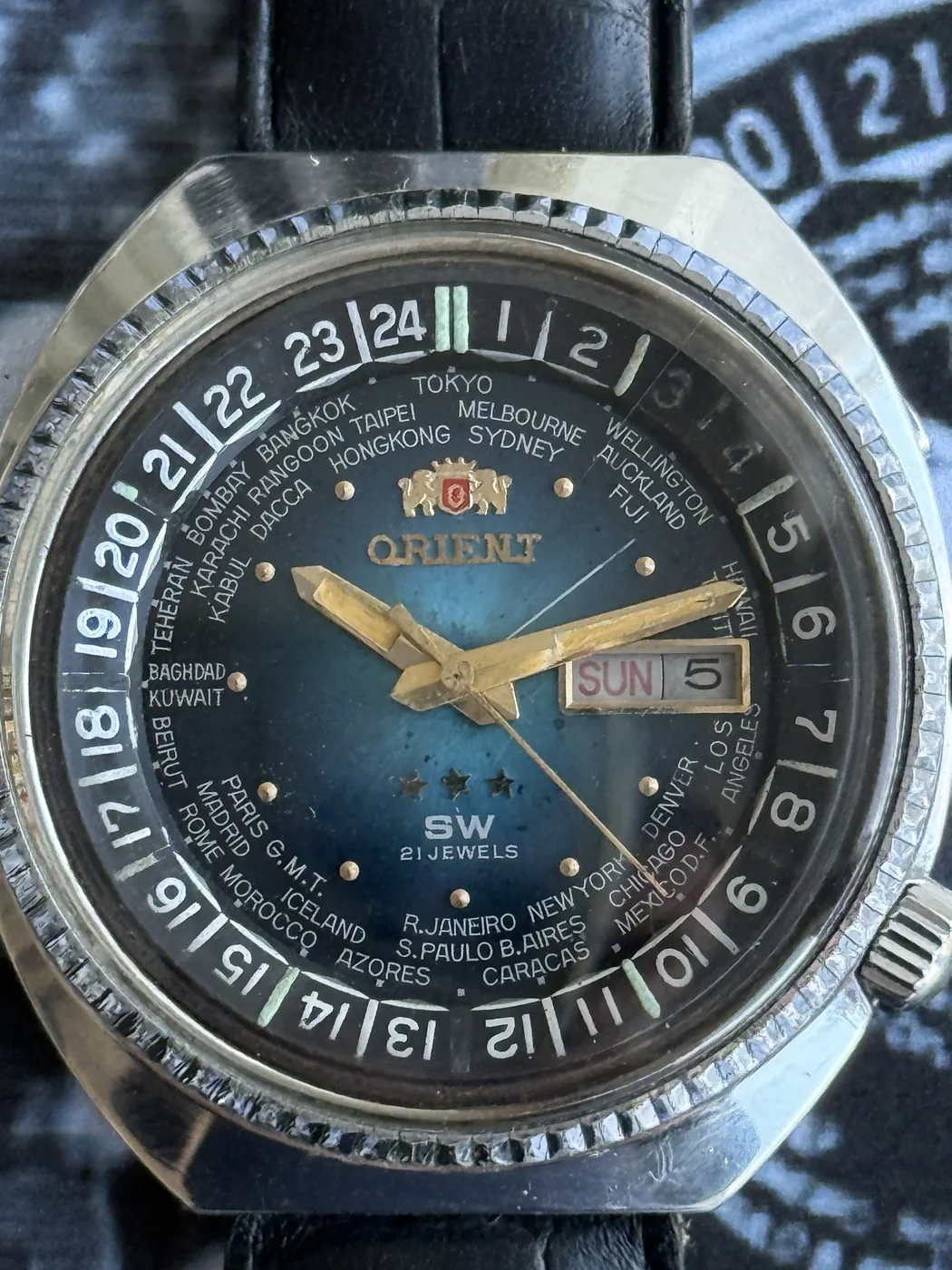
The world on your wrist. On 1 April 1964 Japan lifted its restrictions on overseas travel, and Japanese businessmen and tourists began to fly the world. Orient answered that same year with the Calendar Auto Orient Swimmer World Trip, and then with its successor: the World Diver, listed under 1969 in Orient's own anniversary timeline (collectors date the first versions to around 1967). Instead of a diving bezel it has a 24-hour inner ring, turned by the second crown at 4 o'clock, and 24 city names printed around the dial — Tokyo, Hongkong, Teheran, Paris, Rio de Janeiro, New York, Los Angeles, Hawaii and more. Set the current hour against your own city and you can read the time anywhere in the world at a glance. Orient's own advertisement for Ref. 469622 (shown in the photos) put it simply: “Local time in any part of the world can be found at a glance.”
The SW dial — the one you rarely see. Almost every World Diver offered for sale carries “WD” above “21 Jewels”. This one says “SW”, beneath Orient's three stars. Orient never published what SW stands for. The most likely reading is Swimmer: the name Orient gave its water-resistant watches from the early 1960s, and the name of the World Diver's own predecessor, the Swimmer World Trip. (The “Sea World” name some sellers use has no source behind it.) WD dials come up for sale all the time; SW dials only now and then.
Model: Orient World Diver, “SW” dial
Reference: Y469622-7A
Caliber: 46941 (automatic, 21 jewels, day/date)
Dial: Blue-green gradient, 24 world cities, 24-hour inner ring
Price: €475
Import costs and VAT are the buyer's responsibility.
More Orient Watches Available Now

Orient Royal Calendar 21J GP, Concentric Kubushi Dots (1961) — €375: A high-grade 21-jewel dress watch with an intricate concentric "tuxedo" dial and raised gold-tone Kubushi minute dots — one of the most visually arresting Orient dials of the early 1960s.
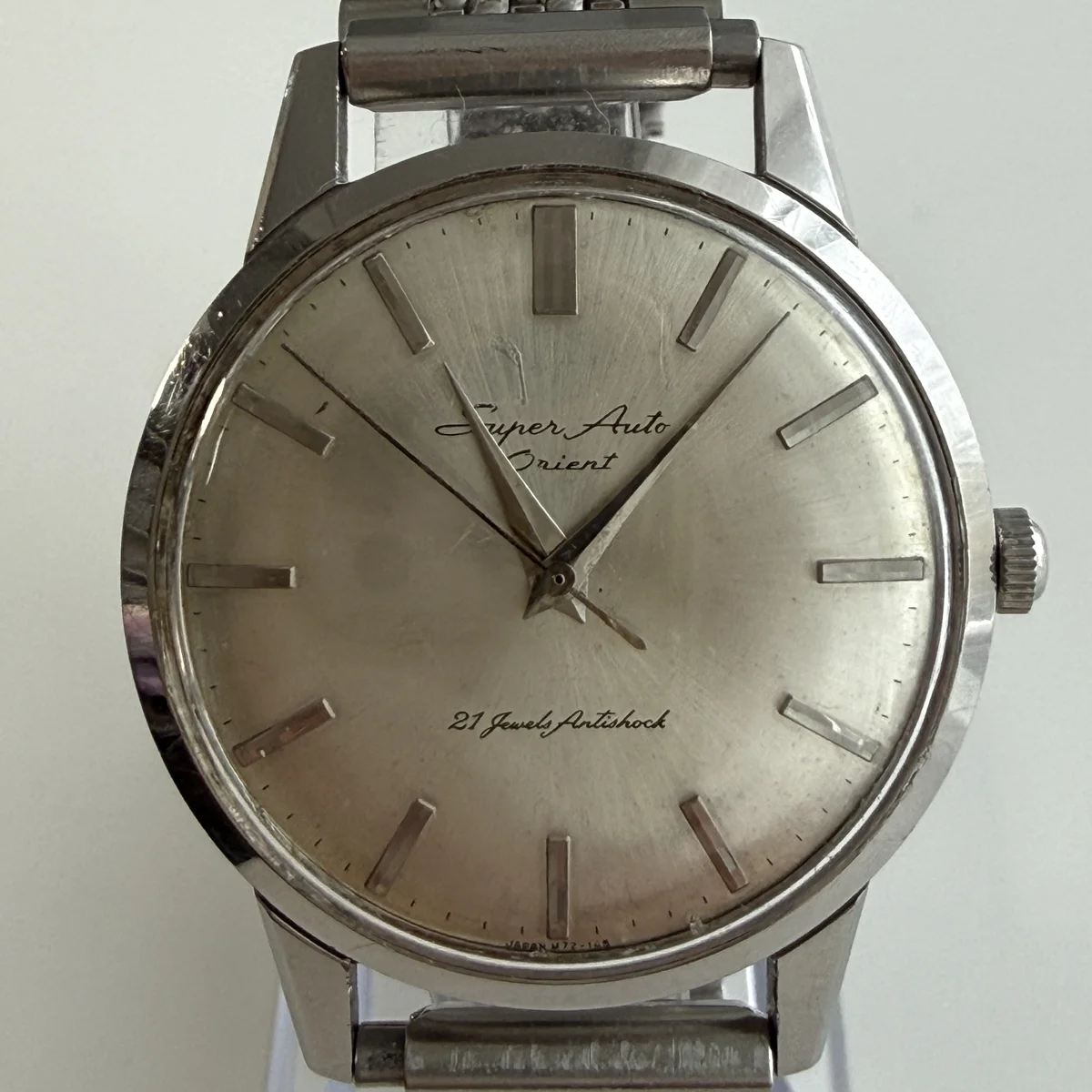
From our archive — Orient's very first automatic, the 1961 Super Auto, which we've had the pleasure of selling. Read the full story →
Orient Super Auto T71087, First Orient Automatic (1961): Orient's very first automatic model, using an IWC Pellaton-inspired winding system — a genuine milestone in the brand's history, on its original steel "Beads of Rice" bracelet.