The Beginning
How It All Started
In the year of European revolutions, 1848, the 23-year-old Louis Brandt opened a small workshop in La Chaux-de-Fonds, Switzerland. His two sons moved the company to Bienne in 1880 — still the home of the Omega factory today. From a revolutionary pocket watch caliber in 1894 to the official watch of NASA's Apollo missions, Omega's story is one of consistent pursuit of the ultimate in precision.
Louis Brandt — La Chaux-de-Fonds
In the year of European revolutions, 1848, the 23-year-old Louis Brandt opened a small workshop in the village of La Chaux-de-Fonds and started Omega. His two sons Louis-Paul and César took over after his death in 1879 and moved to Bienne in 1880 — still the home of the Omega watch factory today.
In 1885 the brothers produced their first pocket watch series caliber — the "Labrador." This advanced caliber formed the basis for further innovations, culminating in the revolutionary 19-ligne caliber in 1894 — and Omega was officially born. Combining time setting and winding through the stem and crown was the way all modern watches worked after their invention. The brothers called their discovery "Omega" — meaning ultimate achievement in Greek. By 1903 they were the largest watch company in Switzerland.
World War I — Official Supplier to the Allies
Omega was the official watch supplier to the British Royal Flying Corps and the U.S. Army during World War I. Their remarkable wartime advertisement read: "For one's safety, one needs to know the exact time, the day and the night." The First World War gave an enormous impulse to the introduction of the wristwatch in everyday life — and after the war, the average man began to wear one instead of only the pocket watch of the wealthy.
Automatic Pioneer & The Marine
In 1931 Omega prototyped the first automatic watch with two weights — the basis of all automatic watches to follow, because it could wind in both directions and dramatically improved winding efficiency. During the 1932 Olympic Games in Los Angeles, Omega was the first choice for timekeeping of all sports results.
In 1932 Omega was also the first to develop a dedicated diver's watch — "The Marine." It used a patented double case holding cork to keep the water out, tested in Lake Geneva to a depth of 75 metres. Omega also introduced an adjustable clasp with a diver's extension. Five years later the watch was tested to 135 metres and became the first choice for many professional divers.
Berlin Olympics
On 1st August the Olympic Games in Berlin were officially opened in a newly built stadium seating 100,000 people — televised for the first time. The Nazi regime had tried to forbid Jews and black athletes from participating, but through the threat of boycott by other countries was forced to give in. To their chagrin, Jesse Owens won 4 gold medals. Omega provided 185 chronographs that took care of the results.
War Supplier & the Seamaster
During the Second World War, Omega was commissioned as the main supplier for the British armed forces and their allies. From the experience of building military watches followed the now iconic Seamaster in 1948 — very durable both in the skies and underwater. Fitted with an early "bumper" automatic movement rotating back and forth 130 degrees (modern ones rotate 360 degrees — you could actually feel it). Width 34mm with nice beefy lugs. Calibers 343 and 350. Originally designed as a dress watch with high water resistance, it later became a diver's watch and James Bond's favourite.
The Tourbillon Wristwatch
A tourbillon is a mechanical device designed to improve accuracy by compensating for the effects of gravity on the timekeeping mechanism. It was Omega in 1947 that was able to put this in a wristwatch, winning many prizes for its efforts. Nowadays Omega is the only watch company in the world to offer automated tourbillons in their models.
The Omega Constellation
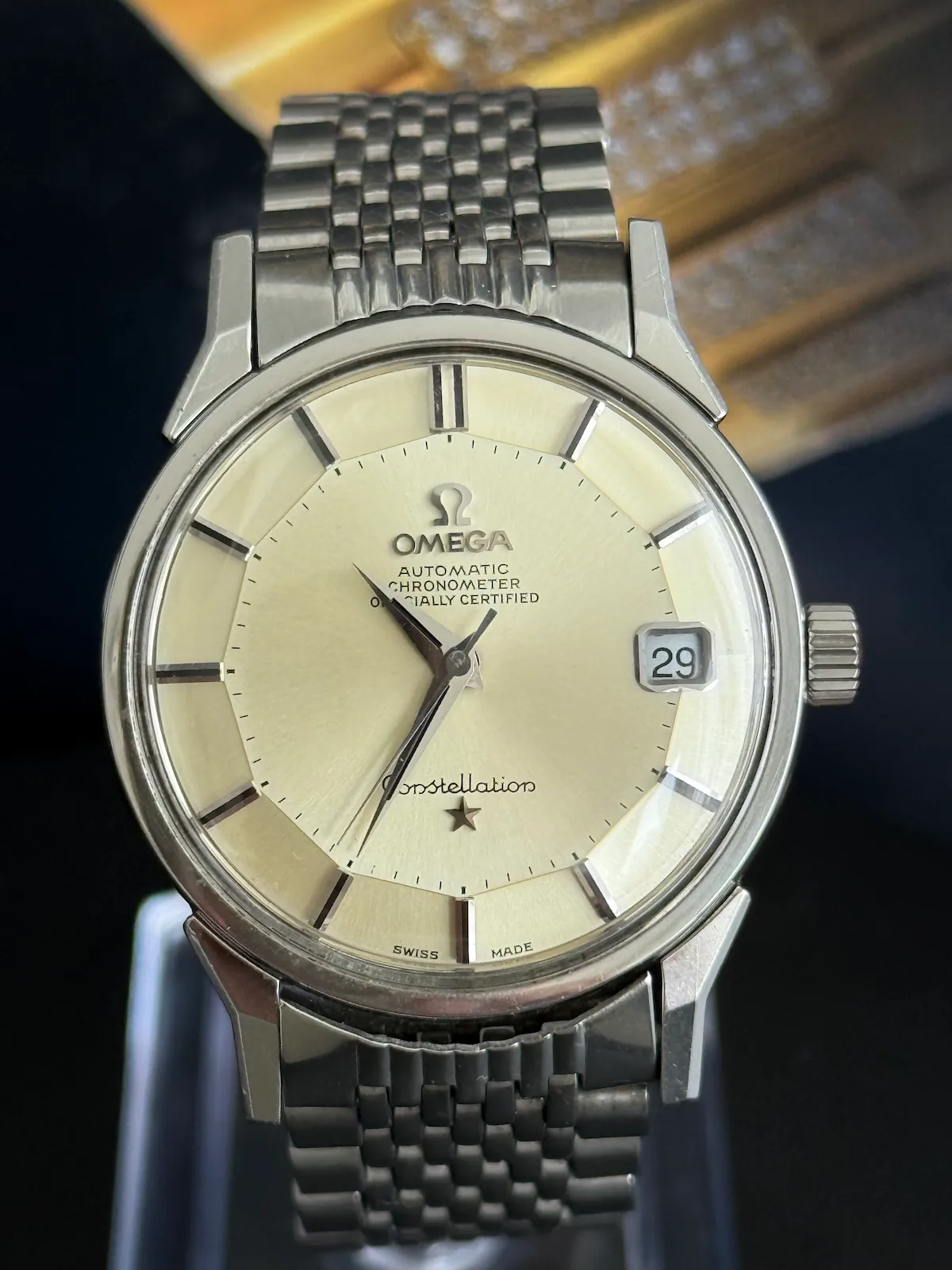
The first Omega Constellation was created in 1952 by René Banwart — who had also designed the Seamaster — and got its name from the emblem at the caseback showing an observatory with 8 stars above it. The eight stars symbolised the 2 chronometer records and 6 first-place awards won by Omega between 1933 and 1952. The Constellation became one of the most iconic dress watches in horological history.
Three Legends Born in One Year
Three icons were born in 1957:
Speedmaster: Designed to be used for space travel for NASA — called "The Moonwatch." In 1962 the first Omega Speedmaster entered space on the arm of astronaut Wally Schirra during the Mercury Sigma mission, flying around the globe six times. In 1965 Omega became the official supplier for all NASA space programmes — a position held to this day.
Seamaster 300: Designed for underwater exploration, withstanding pressure to 300 metres.
Railmaster: Designed to withstand extreme magnetic forces for railway purposes.
Omega De Ville
In 1967 the Seamaster De Ville was simplified into the more streamlined "De Ville" — a sleek, thin cast case attracting a younger crowd as the ultimate dress watch. Available in stainless steel and gold versions. Although well known for their looks, they were outfitted with the best technologically advanced movements — chronometer grade, and even tourbillons and co-axials. Available from the start in square and rectangular cases. Still in production today. The Omega Ladymatic for fashionable women was also produced during this period.
Omega Watches Available Now
 BUY NOW
The Omega Constellation Pie Pan, Cal.564 SS Date (1972, Ref.168.005) — one of the most celebrated Omega dress watches ever produced, with the iconic "Pie Pan" dial in superb original condition.