Most people know Ricoh for cameras and copiers, so a Ricoh watch raises an eyebrow. The short answer to the question we hear most often: yes — vintage Ricoh watches are genuinely good. In the 1960s Ricoh built its own movements, some of them technically more daring than anything else in Japan at the time. Because the name is still little known among watch buyers, they cost a fraction of a comparable Seiko or Citizen. This guide explains where Ricoh watches come from, which models matter, and what to check before you buy one.
Who Made Ricoh Watches?
Ricoh's watches did not start at Ricoh. They started at Takano, a Nagoya watchmaker founded in 1938. After a typhoon wrecked its factory in 1959 and debts piled up, Takano was taken over: on 8 May 1962 the president of Riken Optical (soon to be renamed Ricoh) became Takano's president, and in August 1962 the company became Ricoh Tokei Co. Ltd. — Ricoh Watch Company. It was renamed Ricoh Elemex in 1986 and still exists today.
That matters for quality. Ricoh did not buy movements from someone else; it inherited Takano's factory and, above all, Takano's engineers. Ricoh became the fourth Japanese company to make its own mechanical movements, after Seiko, Citizen and Orient. The full company history is on our Ricoh page.
What Makes Ricoh Watches Good
Three things set the best Ricohs apart:
- In-house engineering with real ideas. The 1963 Ricoh Automat (caliber 1216) was the company's first fully in-house automatic and only 6.4 mm thin. The 1966 Dynamic Wide's caliber 31 was drawn from scratch: its gear train is laid out in the shape of the Greek letter epsilon to make room for an unusually large 9.8 mm balance, it winds in both directions, and you set the date by simply pulling the crown — no pusher, no winding the hands around midnight.
- Ambition. In the "jewel wars" of the early 1960s, Ricoh's Dynamic Auto went to 33 jewels, and then to 45 jewels (caliber 54722) — a count no other Japanese maker matched in 1963.
- A movement family built to last. The Dynamic Wide was such a success that Ricoh built its whole automatic production on the caliber 31 family for the next twenty years. The Ribaron watches of 1969–1970 run on the same base.
Ricoh and Hamilton: The Electric Watches
Ricoh did not only look inward. In 1962, the same year it took over Takano, Ricoh started a joint venture with the American Hamilton Watch Company of Lancaster, Pennsylvania, to make electric watches for the Japanese market. Hamilton had caused a sensation in 1957 with the world's first battery-powered wristwatch, the Hamilton Electric, and the partnership brought that technology to Japan.
The watches were sold as Hamilton-Ricoh Electric. According to collector sources, the electrical parts came from Hamilton in the United States, while Ricoh made the mechanical parts and assembled the watches in Japan, at times more than a thousand a month. The venture ended in 1965; leftover movements, marked "Ricoh 555E", were later cased and sold in the US. Today a Hamilton-Ricoh Electric is a rare find, and a reminder of how ambitious Ricoh was in the early 1960s.
The Honest Downsides
- Parts are scarcer than for Seiko or Citizen. Ricoh made far fewer watches, so spare parts are harder to find. Buy a watch that runs well, ideally one that has been serviced, rather than a project.
- Water resistance is history, not a feature. Some cases were sold as waterproof in the 1960s, but after sixty years the seals cannot be trusted. Treat any vintage Ricoh as not water-resistant.
- Less known means less resale. The low price is the attraction — but do not buy a Ricoh as an investment. Buy it because you like it.
The Main Ricoh Models at a Glance
| Model | Year | Caliber | Why it matters |
|---|---|---|---|
| Dynamic Escort | 1962–63 | 644 (Calendar) | Hand-wound family: no-date, date, and day-date "Day 'n Date" |
| Hamilton-Ricoh Electric | 1962–65 | 555E | Battery-powered electric watch, joint venture with Hamilton |
| Dynamic Auto | 1962–63 | 54710 · 54722 | 33 jewels, then 45 — winner of the jewel wars |
| Automat | 1963 | 1216 | First fully in-house automatic, 6.4 mm thin |
| Auto Deluxe 8 | 1965 | 1218 | Youthful day-date; the "8" marks the day display |
| Dynamic Wide | 1966–68 | 31 · 49 | Ricoh's biggest success, base of 20 years of automatics |
| Ribaron | 1969–70 | Wide 31 base · DII: 74 | New-generation line in five tiers, up to the DII |
The Ribaron: Ricoh's Overlooked Gem
If one Ricoh deserves more attention, it is the Ribaron. The line launched in February 1969 as Ricoh's new standard model, at a turning point for the company: founder Kiyoshi Ichimura had just died, and the Ribaron was meant to show the new direction under president Takeshi Ōue. The name most likely combines "Ri" from Ricoh with "Baron" — a title of nobility, the same idea Seiko used for its "Lord" models.
The range grew into a five-step ladder: Ribaron, Ribaron S, Ribaron SII, Ribaron D and Ribaron DII. All are built on the Dynamic Wide's caliber 31 family. The Ribaron DII, introduced in October 1970 with caliber 74 and 26 jewels, sits at the top. It is the only Ribaron with hacking seconds (the second hand stops when you set the time) and a push-button quick-set date through the crown. At launch it was the most expensive Ribaron, at ¥15,500.
What to look for on a Ribaron D or DII:
- The faceted crystal. The D and DII came with a nine-sided, diamond-cut glass, used on no other model. Many have been replaced with a plain crystal over the years; an original one is a real plus.
- The dial signature. On the D and DII the dial reads "RICOH", with the Ribaron name printed in block letters and the D or DII designation applied beneath it as a separate badge. Compare this closely with good reference photos — it is the quickest way to spot a reproduction dial.
- Rarity. The plain Ribaron and Ribaron S turn up now and then. The DII, especially with its faceted crystal intact, very rarely does.
What to Check Before Buying Any Vintage Ricoh
- The dial. Look for crisp, even printing. Thick or blurry letters, or a dial that looks too perfect next to a worn case, can mean a refinished ("redial") dial, which lowers the value.
- The date and day. On a Dynamic Wide, pull the crown to the second position: the date should jump one day each time. On a Ribaron DII, test the push-button quick-set.
- The winding. An automatic should start running after a gentle shake. A grinding or scraping feel can point to a worn rotor.
- Gold plating. Many Ricohs were gold-plated (GP). Some wear on the lugs and bezel is normal for sixty years; bare brass showing through over large areas is not.
- The case back. Check that the reference and caliber on the case back match the model on the dial.
What Does a Vintage Ricoh Cost?
This is the pleasant part. Good, running Ricohs from the 1960s are still affordable: in our shop they range from about €225 to €425. Rare variants, such as a 45-jewel Dynamic Auto or a late Dynamic Wide Special, ask more — when you can find one at all. For an in-house Japanese automatic from the 1960s with a real story behind it, that is very good value.
Ricoh Watches in Our Shop Now
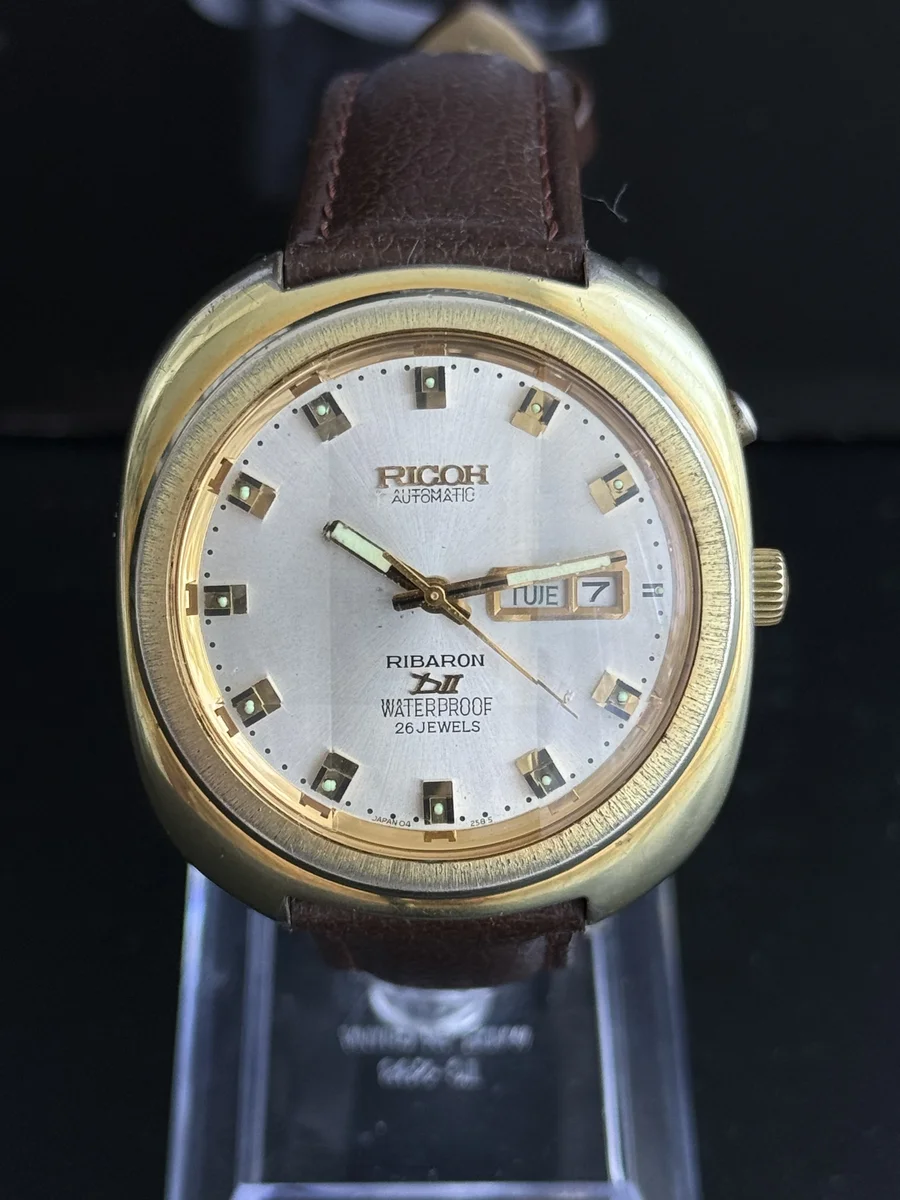


- Ricoh Ribaron DII, 1970 — caliber 74, 26 jewels, original faceted crystal — €245
- Ricoh Dynamic Wide, 1966, ref. 30804 — the very first Dynamic Wide, caliber 31, 25 jewels — €425
- Ricoh Auto Deluxe 8, 1965 — caliber 1218, 21 jewels, day-date — €375
- Ricoh Dynamic Escort Calendar, 1963 — caliber 644, 23 jewels, hand-wound, the scarce date-only version — €225
Import costs and VAT are the buyer's responsibility.
From Our Archive — Ricohs We Had the Pleasure of Selling

From our archive — the Ricoh Dynamic Auto 45 Jewels of 1963, winner of the jewel wars. Sold.


- Ricoh Dynamic Auto 45 Jewels, 1963 — caliber 54722, the 33-jewel base plus a 12-jewel ruby ball-bearing rotor, on its original "R" deployant bracelet. Sold.
- Ricoh Dynamic Auto 33 Jewels, 1962 — caliber 54710, with instant day and date change. Sold.
- Ricoh Automat, 1963 — caliber 1216, Ricoh's first in-house automatic. Sold.
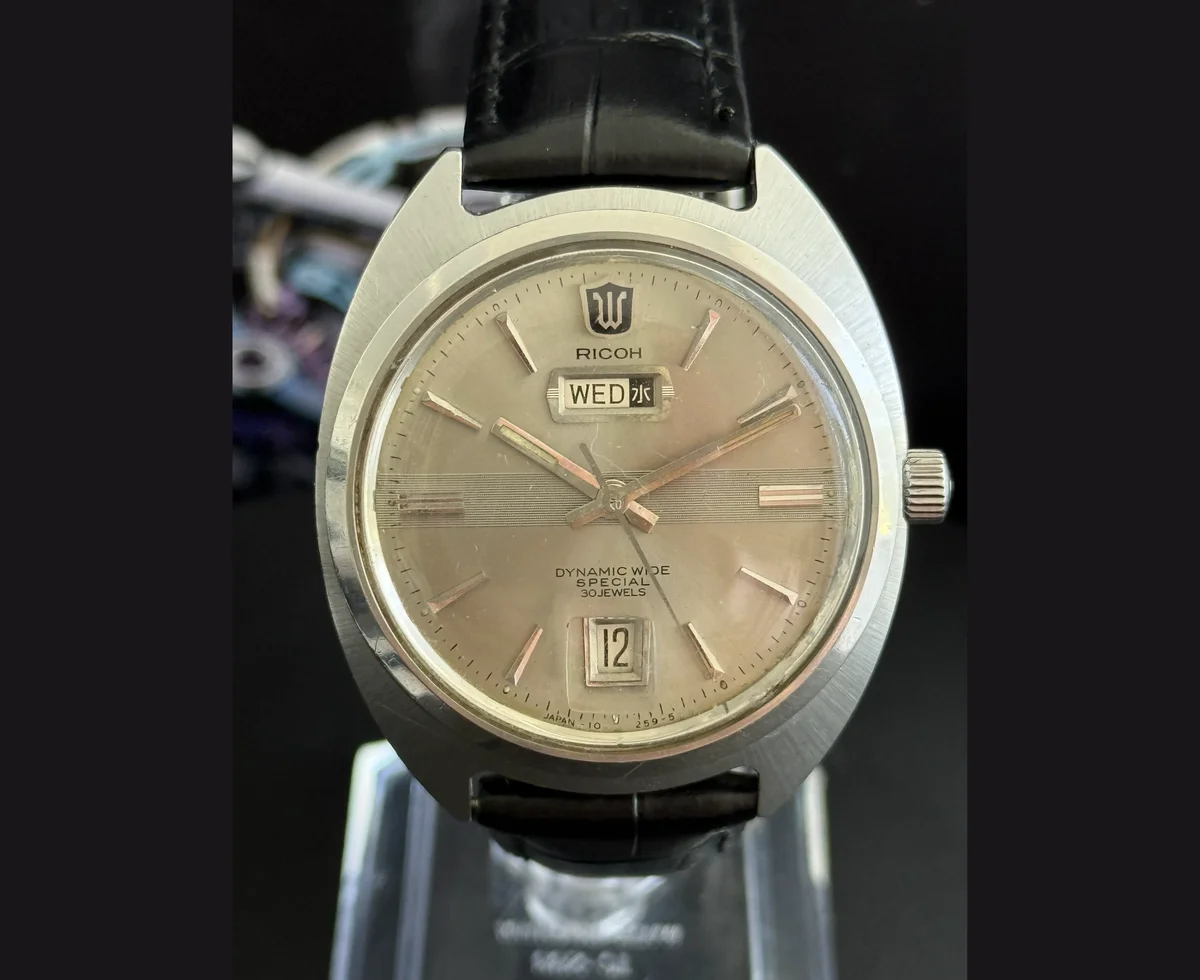
- Ricoh Dynamic Wide Special, 1968, ref. 49801 — 30 jewels, the final "Special". Sold.
Frequently Asked Questions
Is Ricoh a good watch brand?
Yes. In the 1960s Ricoh made its own movements, building on the engineers and factory it took over from Takano. Its best calibers, such as the Dynamic Wide's caliber 31, are well designed and have proven durable.
Does Ricoh still make watches?
The watch company, Ricoh Elemex, still exists, but the mechanical watches collectors look for were made in the 1960s and 1970s.
Are Ricoh watches automatic?
Many are. The Automat, Dynamic Auto, Auto Deluxe 8, Dynamic Wide and Ribaron are automatics; the Dynamic Escort family is hand-wound.
Which vintage Ricoh should I buy first?
A Dynamic Wide or a Ribaron: they use Ricoh's best and most widespread movement family, and they wear well today.
More Ricoh History
For the full story — from Takano's typhoon to the Ichimura rescue plan — read our Ricoh page. The story of the man who designed the Dynamic Wide is told on the Dynamic Wide page, and Ricoh's roots are on our Takano page. Looking for other Japanese makers? See our guide to Japanese vintage watches for sale.
Questions about a Ricoh or about shipping? Reach out via our contact page.