
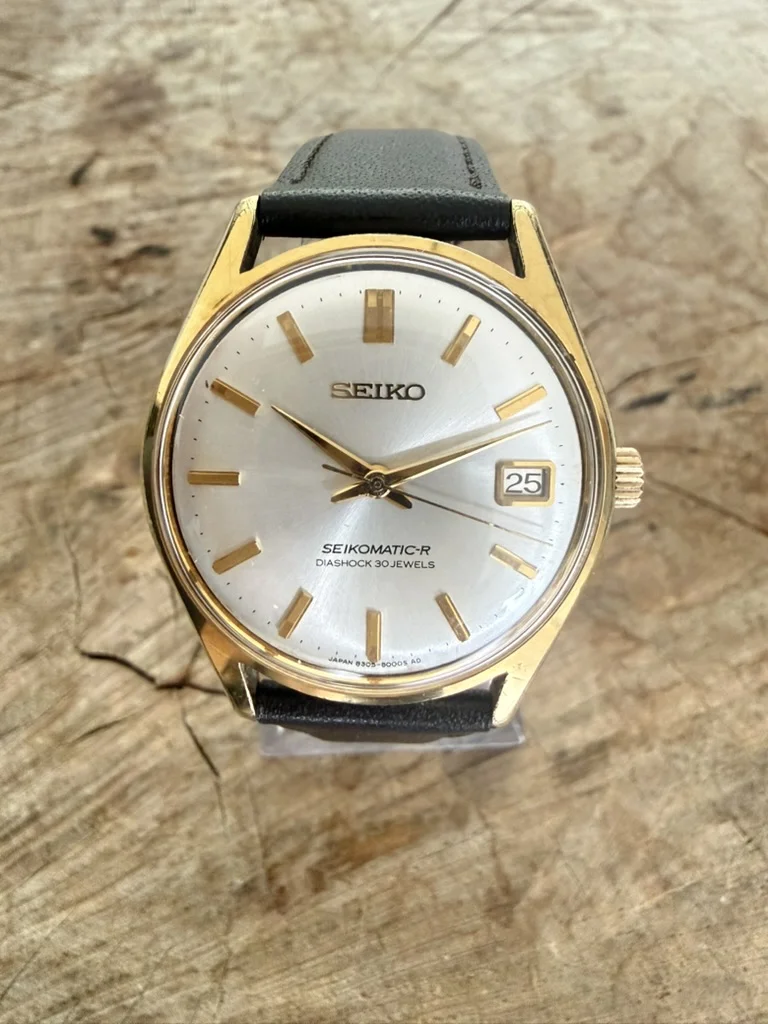
When you mention "Seiko automatic" from the 1960s to most collectors, they immediately think of the mighty 62-series movements: the durable, ubiquitous powerplants that would eventually form the foundation of the Grand Seiko. But in the corporate corridors of early 1960s Japan, something else was brewing — a quiet competition between two rival Seiko facilities that would produce some of the era's most overlooked mechanical watches.
Suwa Seikosha, in the mountainous Nagano region between Tokyo and Nagoya, and Daini (Seiko's Tokyo division) were locked in a sustained battle for engineering supremacy. Grand Seiko versus King Seiko. 62-series versus 83-series. And perhaps most tellingly for the business market: the Seikomatic-R versus the Seikomatic-P.
Today, we explore both — two distinct philosophies in watchmaking, both remarkable in their own way, both criminally undervalued.
The Seikomatic-R: Suwa's Answer to the Salaryman
Origins of the Slim
When the Seikomatic Slim debuted in August 1963, it announced a clear design objective: thinness. Not for fashion's sake, but for practicality. The emerging Japanese executive class — the "salaryman" — needed a watch that would slip beneath tailored business cuffs without creating an obvious bulge. The competition was fierce, and Seiko's Suwa division responded with elegant engineering.
The answer was the 83-series movement: a wholesale rethinking of automatic winding architecture. Rather than bolting an automatic module onto a manual-wind base (a common approach that added bulk), the 83-series integrated the rotor and winding mechanism directly into the movement's foundation. The result was a movement that beat at a leisurely 18,000 bph and measured just 3.8mm thick — a full millimetre thinner than the 62-series and dramatically more elegant under the cuff.
The base 830 caliber was time-only, but by 1965, the 8305 arrived with a date complication, and later variants added manual hand-winding capability. The movement was highly jeweled — not for marketing gloss, but because each jewel was actually functional. A Seikomatic-R with 30 jewels had earned them through engineering necessity, not accounting sleight of hand.
The Business-R and Gold-Plated Heritage
By the mid-1960s, the "Seikomatic-R" branding began giving way to "Business-R" and later "Business-A" — names that explicitly targeted the white-collar market. The watches themselves maintained their refined 83-series calibers (the 8305, 8306, 8325, and 8346 variants), but the marketing shifted: these were watches for the boardroom, not the workbench.
Gold-plated variants appeared regularly, and the 8346A movement — a slightly detuned 27-jewel version of the 30-jewel 8306A — became the standard for many Business-R models. The plating would wear, as it always does over 60 years, but the movement underneath remained a technical marvel: a slim-line automatic with manual wind, quick-set date, and the sophisticated reverser-wheel system that gave the 83-series its reputation for reliability.
A Watch for the Wrist, Not the Workbench
The 83-series philosophy was one of restraint and refinement. At roughly 34–38mm (depending on variant), these watches were slightly smaller than their 62-series cousins, but they wore considerably thinner. The cases were often dressed in subtle numerals or applied indices — no dive bezel drama, no tool-watch aesthetics.
What made the Seikomatic-R genuinely special was its honesty: it promised understated elegance, integrated automatic winding, and solid timekeeping — and delivered precisely that, without theatrical complications or unnecessary finishing touches.
The Seikomatic-P: Daini's Slim-Line Gambit
A Shorter, Sharper Silhouette
While Suwa was perfecting the business-watch aesthetic in the form of the Seikomatic-R, Daini — Seiko's Tokyo facility — was plotting something bolder. In 1965, it introduced the 51-series movements, and by 1967, those movements had found their definitive home: the Seikomatic-P.
Where the Seikomatic-R was about refinement, the Seikomatic-P was about ambition. It was produced for only two years (1967–1969), and only four or five distinct models were ever made. Yet in that brief window, Daini packed more engineering sophistication into the 51-series family than almost any contemporary business watch.
The most celebrated model is the 5106-8010 — a watch whose squared-off lugs and clean geometry drew clear inspiration from the second-generation Grand Seiko, suggesting that Daini viewed this as something more than a stopgap professional piece.
The 5106A: A Technical Tour de Force
Every Seikomatic-P housed the identical 33-jewel 5106A caliber — and this is where Daini's ambition becomes evident. This movement was a masterpiece of compact complexity, measuring approximately 37mm in diameter but containing roughly 150 separate components, each functioning with purpose.
The headline features:
- 33 jewels, every one of them functionally positioned (no marketing fluff)
- Hacking seconds (pull the crown and the seconds hand stops — a luxury feature)
- Integrated automatic winding designed at the train-wheel level
- Integrated manual winding capability
- Day-date instant changeover mechanism
- Quick-set date button in the crown center
But the true genius was hidden: a go-and-back sweep seconds system. Rather than a simple fourth wheel driving a seconds hand, the 5106A employed dual third wheels on a common shaft, creating reciprocal power transfer that allowed for seamless, friction-free seconds operation.
The Calendar: A Rat's Nest of Genius
The day-date mechanism in the 5106A is possibly the most complex calendar design Seiko produced during that era. It features an "eagle beak shaped lever" that flicks the date wheel at precisely the right moment, coordinated through a characteristic cam atop the date-driving wheel. Springs nest within springs; tiny movements cascade into one another. It is, frankly, a nightmare to service — but that nightmare is also a demonstration of pure horological ambition.
The quick-set date, operated by depressing a button in the crown center, functions in both directions. This was cutting-edge convenience in 1967. Most competitors were still requiring collectors to spin the date around manually through the entire month.
Where Suwa Met Daini in the Market
Here's what's remarkable: the Seikomatic-R and Seikomatic-P occupied nearly identical market territory. Both targeted the business professional. Both offered slim-line profiles and integrated automatic winding. Both were positioned one tier above basic automatics but well below the prestige Grand Seiko / King Seiko lines.
Yet they approached the brief from opposite angles:
- Seikomatic-R (Suwa): Conservative, refined, understated. 30 jewels. Traditional quick-set date. Emphasis on simplicity and reliability.
- Seikomatic-P (Daini): Ambitious, technically complex, pushing boundaries. 33 jewels. Dual quick-sets (date by button, day by repeated time-cycling). Emphasis on engineering sophistication hidden beneath a clean dial.
In the 1960s marketplace, the Seikomatic-R arguably won — it was more widely produced, more readily understood, less demanding to service. The Seikomatic-P was discontinued by 1969, while the 83-series lingered under the "Business-A" branding into the early 1970s.
Collecting the Seikomatic Family Today
Why They're Undervalued
If you visit a vintage watch forum and mention "Seikomatic-P," you'll find passionate discussions — but fewer than 50 actual examples publicly documented in the collector community. The Seikomatic-R is slightly more visible, but even a pristine 8306 or 8346 will cost a fraction of a contemporary Omega or Bulova of equal condition.
Because Seiko, for all its current prestige, was dismissed as a "mass-market brand" for decades. Because business watches and dress watches don't command the same nostalgia as sports divers. Because the 62-series Grand Seiko got the historical narrative while the slim-line 51-series and 83-series were left in footnotes.
That's a collector's opportunity.
What to Look For
Seikomatic-R (83-Series):
- Original dial with clear printing
- Correct caliber markings (8305, 8306, 8325, or 8346)
- Original bracelet (if present) is a significant plus
- Case wear is expected; plating loss on gold variants is cosmetic, not structural
- Hacking second hand is NOT present on 8305/8306/8346 variants (this is normal)
- Look for working quick-set date
Seikomatic-P (51-Series/5106A):
- Blue dial variants are rarer than black or silver
- Original Seiko bracelet is increasingly scarce
- All models should have both day and date windows
- Quick-set date button in crown center should function smoothly (both directions)
- Hacking seconds hand is present (pull crown, hand stops)
- New crystal is acceptable; original gaskets should be replaced
The Service Reality
Both families can be serviced by a competent watchmaker, but neither is beginner territory. The Seikomatic-R is relatively straightforward — the 83-series is accessible to intermediates. The Seikomatic-P's 5106A calendar mechanism is genuinely complex; most collectors will want to leave this to professionals.
Parts availability is mixed. The major components (mainspring, balance, jewels) are standard. But certain dial guard screws or specific calendar components can be impossible to find new and require careful sourcing from junker movements or specialist suppliers.
A Collector's Conclusion
The Seikomatic-R and Seikomatic-P represent two distinct moments in Seiko's internal competition. The R is the refined, cautious engineering of Suwa — all the features you need, nothing you don't, built to last. The P is the ambitious, technically daring engineering of Daini — pushing boundaries in calendar complexity, in quick-set functionality, in the integration of automatic and manual winding systems.
Neither became a legend. Both were discontinued within a decade. But if you're a collector who values engineering substance over marketing narrative, who appreciates the whisper of a well-finished movement over the roar of a chronograph, these watches deserve your attention.
They're underappreciated. They're undervalued. And they're filled with the kind of mechanical sophistication that vanished once quartz arrived.
That's not a flaw. That's a feature.
Available at VintageWatchesDirect
We currently have both examples in stock:
- Seikomatic-P 5106A — Blue dial, original bracelet, new crystal, 33-jewel caliber with hacking seconds and quick-set date. Excellent condition.
- Seikomatic-R 8346A — Gold-plated, 27-jewel caliber, day-date function, original finish. Ready for restoration or daily wear.
Both watches tell the story of Seiko's golden age. Both reward research and appreciation. If you'd like to discuss either piece, or have questions about specifications and pricing, please reach out via our contact page.