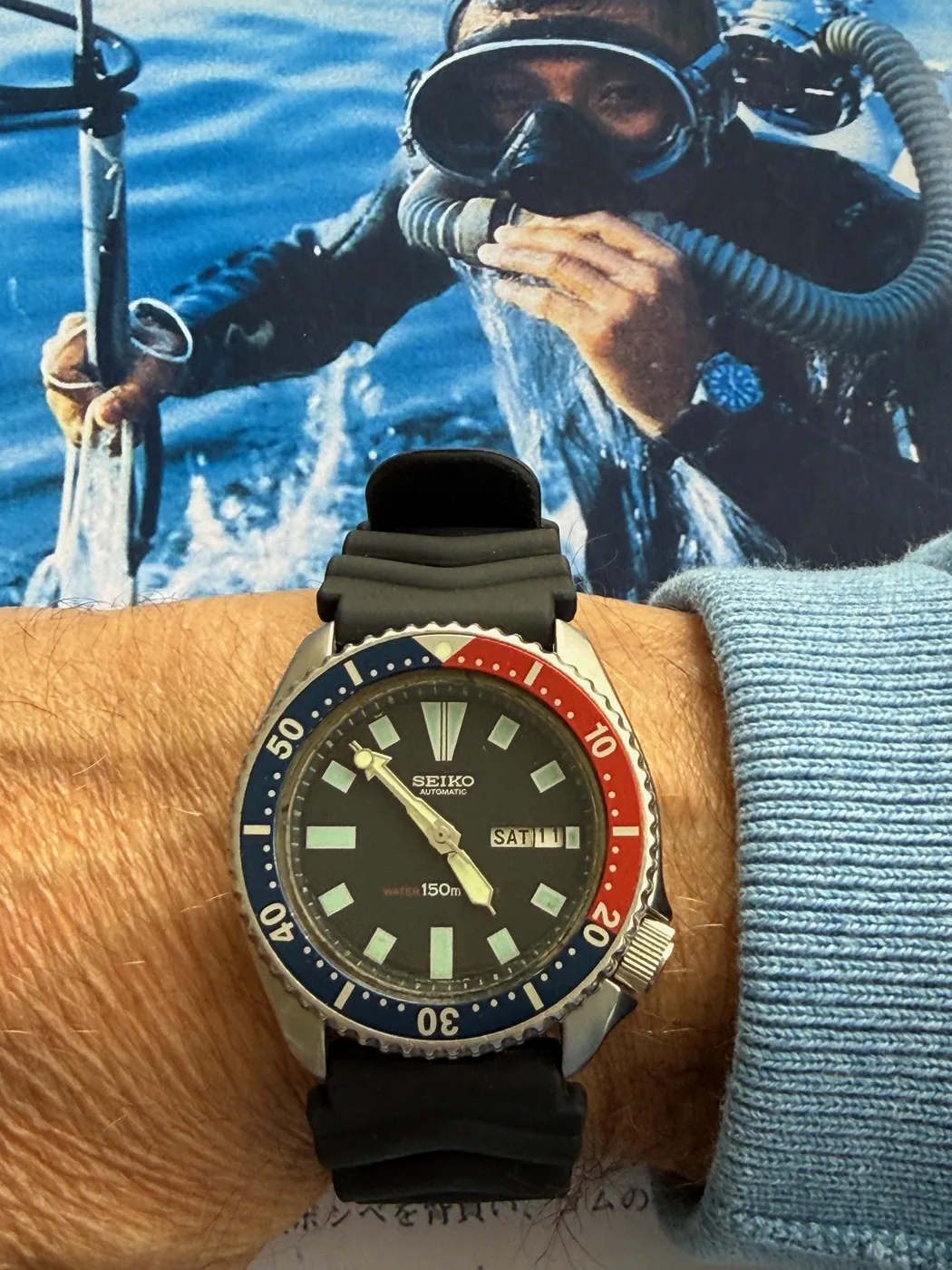
1965: The 62MAS — Where It All Began
Every Seiko diver, the Turtle included, goes back to one watch: the 62MAS of 1965. It was Seiko's first diver's watch and Japan's first, launched at a time when scuba diving was becoming a popular sport in Japan and divers needed something tougher than an ordinary wristwatch.
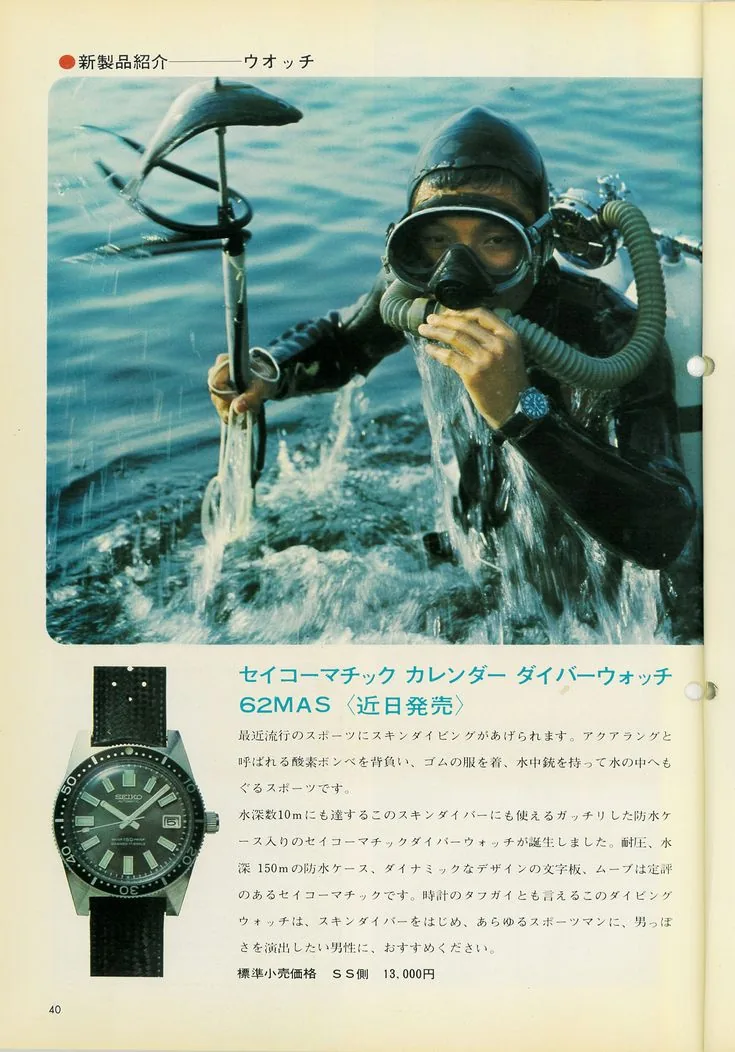
“Coming soon”: the Japanese Seiko page that announced the Seikomatic Calendar Diver Watch 62MAS in 1965, at a price of ¥13,000 in stainless steel.
The name tells you what it is: a 62-series Seikomatic movement, Automatic winding and a Self-dater. Inside was the caliber 6217, 17 jewels, ticking at 18,000 beats per hour. The steel case was only about 37 mm across — modest by today's standards — but it was water resistant to 150 metres, with a rotating bezel to time a dive, a date at 3 o'clock and big luminous markers.
The page above, announcing the watch as “coming soon”, describes it as a sturdy diver for skin divers and for every sportsman who wants to show a bit of masculinity — and it priced the watch at ¥13,000. Look at the picture: a diver coming out of the water with a speargun in one hand and the 62MAS on his wrist. It is the same kind of image Seiko would use again for the Turtle a decade later.
The 62MAS earned its reputation the hard way. From 1966 it went south with the Japanese Antarctic Research Expedition, and it proved that a Japanese watch could survive cold, pressure and hard work. It was only made until 1968, which makes a good original rare and expensive today, and Seiko has reissued it several times as a tribute to its first diver.
The design ideas of the 62MAS — a strong steel case, a rotating bezel, big lume and 150 m of water resistance at a fair price — became the recipe for every Seiko diver that followed, from the 6105 of the late 1960s to the Turtle.
From the 62MAS to the Turtle
Few dive watches have a nickname that explains itself as well as this one. Put a Seiko 6309 on a table, look at it from the side, and you see it straight away: a wide, rounded, cushion-shaped case with the bezel sitting on top like the shell of a sea turtle. Collectors started calling it the Turtle decades ago, and Seiko liked the name so much that it eventually adopted it for its own modern models.
This is the story of that family — from the first Turtle of 1976, through the export Turtles and the smaller 1980s Slim Turtle, to the Prospex Turtles you can still buy new today. And it ends with the one we have in stock: a Pepsi-bezel Slim Turtle from October 1986.
1976: A Diver for Everyone
By the mid-1970s Seiko already had a serious reputation under water. After the 62MAS, the 6105 divers of the late 1960s and early 1970s had been worn everywhere from fishing boats to jungle patrols. What Seiko wanted next was a diver that was simpler, tougher and cheaper to make — a watch for ordinary people who swam, sailed or simply worked hard with their hands.
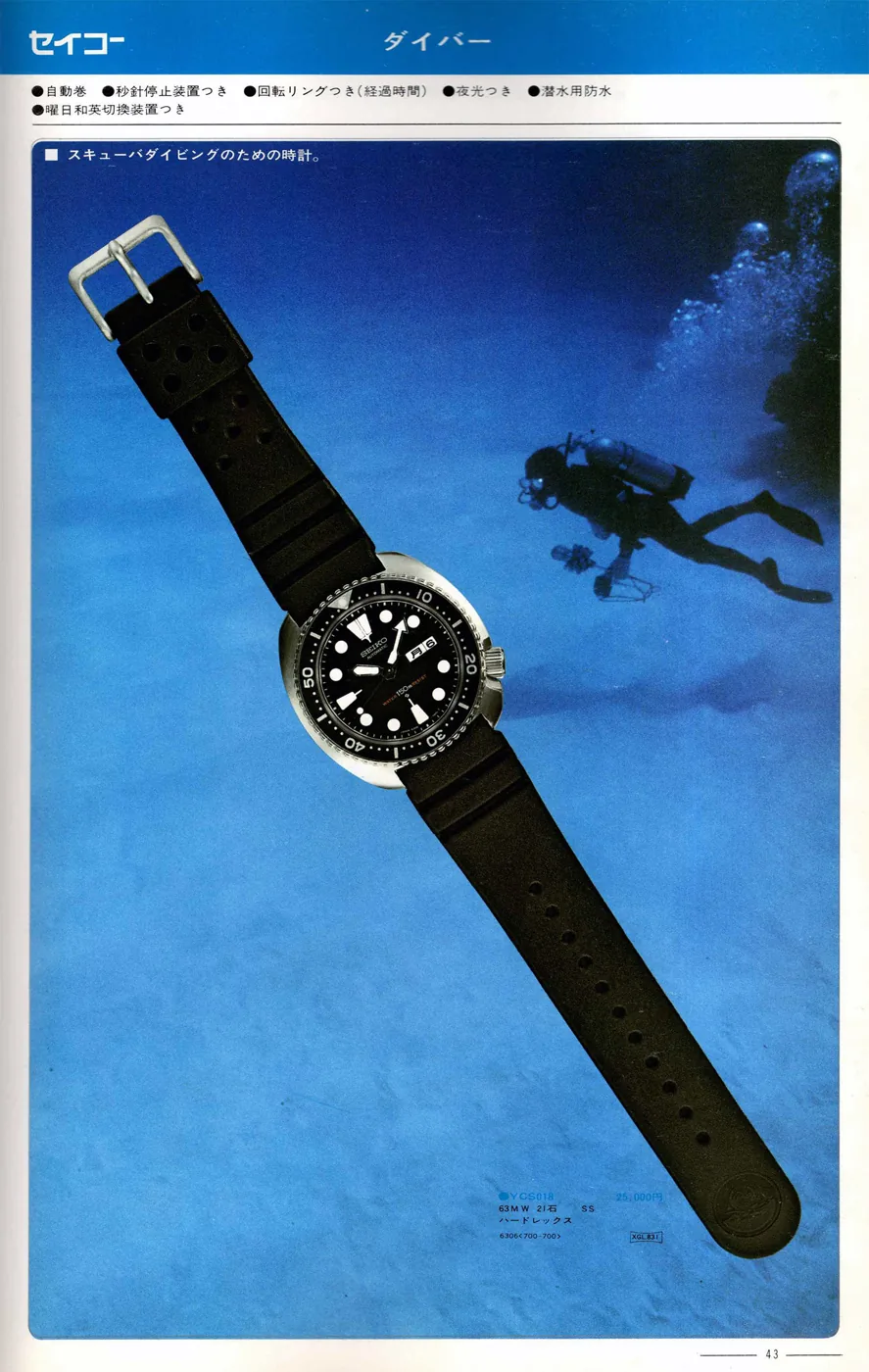
The Turtle as Seiko presented it: a page from the 1977 Japanese Seiko catalogue, volume 1. Scan via The Seiko Guy.
The answer was presented in Japan in August 1976: the 6306-7000 (followed by the 6306-7001), domestic reference YCS018. Everything about it was practical. The case was a broad, rounded cushion of stainless steel, around 45 mm across, with the crown moved to 4 o'clock and screwed down, so it could not dig into the back of your hand. It was water resistant to 150 metres, came on a polyurethane strap and carried a big, legible dial with day and date at 3.
Inside was the caliber 6306: automatic, 21 jewels, 21,600 beats per hour, and — unusually for an affordable Seiko of the time — with hacking seconds, so the seconds hand stops when you pull the crown to set the time.
A few Japanese-market 6306s carry special dials that collectors chase today. Some were made for the dive-equipment company Scubapro ("Scubapro 450"), and others were issued for the MSSTS expeditions to the McMurdo Sound in Antarctica (1978–79 and 1979–80). Because these dials are worth far more than a standard one, many fakes exist — reprinted dials on ordinary 6306 or 6309 watches. If you are offered one, ask for proof.
The Export Turtle: 6309-7040 and 6309-7049
For the rest of the world Seiko built the Turtle around a simpler engine: the caliber 6309. It is the same basic design as the 6306, but with 17 jewels and without hacking. It winds itself with Seiko's Magic Lever system, cannot be wound by hand, and runs for roughly two days on a full wind. On paper that sounds like a step down; in practice the 6309 became one of the most robust everyday automatics Seiko ever made, and today it is one of the easiest vintage movements to service and find parts for.
The export watch was the 6309-7040 (catalogue reference DE091), with the 6309-7049 (DE095) as the North American version — the same roughly 45 mm by 13 mm cushion case, the same 150 m rating, the same crown at 4. These are the watches most people mean when they say "vintage Turtle". They were sold in huge numbers, worn hard by divers, sailors and soldiers, and produced until 1988, when the 7002 divers took over.
1982: The Slim Turtle
A 45 mm cushion of steel is a lot of watch, especially in the early 1980s, when most men's watches were 35–37 mm. So in 1982 Seiko gave the export market a smaller, sharper sister: the 6309-729x. It kept the 6309 movement, the day-date, the 150 m rating and the crown at 4 o'clock, but the case is slimmer and more angular, with a trimmer profile that sits lower on the wrist. Sources give the diameter as about 41–42 mm.
Collectors call it the Slim Turtle. It came in three colours: black, the navy-and-red "Pepsi" and a bright orange dial, which was made mostly between 1982 and 1985 and is the scarcest today. On casebacks, dials and in catalogues you will find the codes 6309-7290, 6309-729A and 6309-729B for this family.
The caseback of our Pepsi example simply reads 6309-7290, along with Seiko's embossed tsunami-wave emblem — the mark of a genuine Seiko diver. Production ran until about 1988, together with the full-size Turtle.
The Three Turtle Movements Side by Side
| Spec | 6306 (Japan, 1976) | 6309 (export, 1976–1988) | 4R36 (Prospex, 2016–) |
|---|---|---|---|
| Winding | Automatic | Automatic | Automatic + hand-winding |
| Jewels | 21 | 17 | 24 |
| Beat rate | 21,600 bph | 21,600 bph | 21,600 bph |
| Hacking seconds | Yes | No | Yes |
| Hand-winding | No | No | Yes |
| Power reserve | about 2 days | about 2 days | 41 hours |
2016: The Turtle Comes Back
After almost thirty years away, the Turtle returned at the end of 2015 as part of Seiko's Prospex line. The new watches — the SRP773, SRP775, SRP777 and SRP779 — kept the cushion case at 45 mm and the crown at 4 o'clock, but used the modern caliber 4R36, which can be wound by hand and has hacking seconds. The black SRP777 is the one closest to the original; in Japan it was later sold as the SBDY015.
The revival was a hit, and Seiko has made dozens of versions since. Collectors gave many of them their own nicknames: the Batman (SRP787, blue and black bezel), the Coke (SRP789, red and black), the PADI editions made with the diving organisation, and the Save the Ocean models that support sea-conservation projects. There are also many limited regional editions — Thailand, Australia, the Philippines, Taiwan and more.
In 2020 came the King Turtle: the same cushion case, but with a sapphire crystal, a date magnifier and a textured "waffle" dial. In 2025 a King Turtle was even made to mark fifty years of the film Jaws, limited to 5,000 pieces.
Why Choose a Vintage Turtle?
A new Turtle is a fine watch, but a vintage one has something no reissue can copy: it was there first. The 1970s and 1980s Turtles were not collector pieces when they were made — they were tools, bought to be worn. Every scratch on the case and every bit of patina on the lume is real history.
And the Slim Turtle adds one more argument: size. For many wrists the full 45 mm Turtle is simply too big. The Slim Turtle gives you the same movement, the same dial and the same diver character in a case that fits a normal wrist and slides under a shirt cuff.
What to look for when you buy one:
- Dial — check that the printing is sharp and even. Reprinted ("redial") and aftermarket dials are common, especially on the rare versions.
- Bezel insert — original inserts fade with age; a bright, perfect insert may be a replacement. Neither is a problem, but it should be honest and reflected in the price.
- Caseback — the serial number dates the watch: the first digit is the year, the second the month (1–9, then O, N, D for October, November, December).
- Water resistance — after forty years the gaskets are almost always tired. Treat any vintage Turtle as not water-resistant until it has been serviced and pressure-tested.
- Service — the 6309 is very easy to service, and parts are widely available. That makes it a sensible first vintage diver.
Our Slim Turtle — October 1986, Pepsi Bezel

In the shop now: our Seiko 6309-7290 Slim Turtle from October 1986, €495.
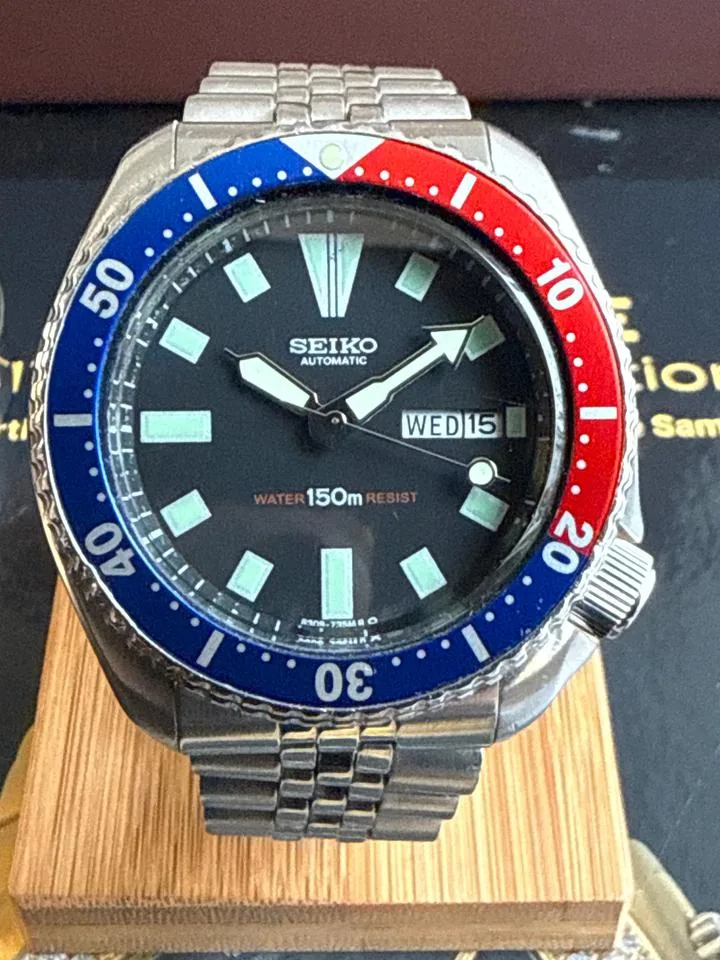
The watch in our shop is a Pepsi-bezel Slim Turtle, caseback 6309-7290, serial 602404: October 1986. It has the classic look — black dial with fat lume plots, the long arrow minute hand, day-date at 3 and "WATER 150m RESIST" in red and white — inside a cushion case with the crown at 4 and the tsunami wave on the back. Inside is a caliber 6309A, 17 jewels, signed "JAPAN 6309A SEVENTEEN 17 JEWELS".
It runs well: we wore it day and night for 48 hours, it kept running through both nights without stopping, and it lost only about 2 minutes a day. The case shows honest light scratches. All of it is visible in the 16 photos and the video on the watch's own page.
Read the full description, see all photos and the video →
Import costs and VAT are the buyer's responsibility.
From Our Archive — Two Slim Turtles We Had the Pleasure of Selling
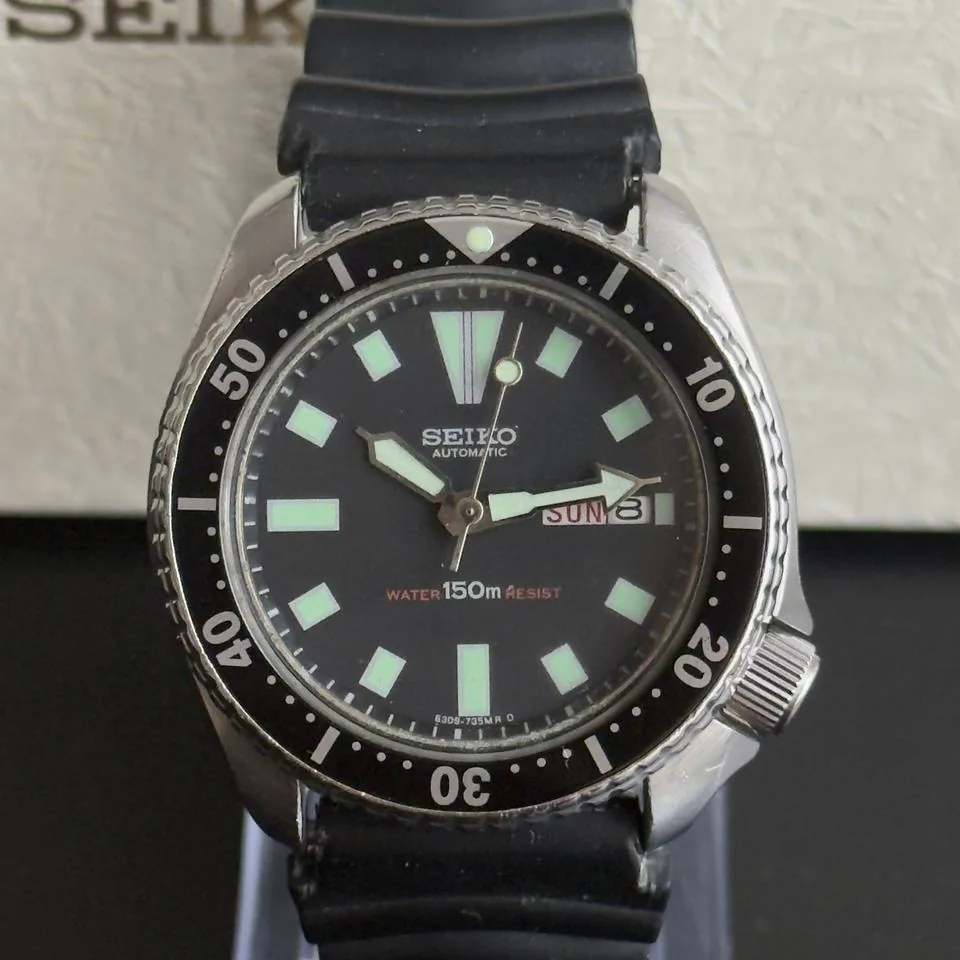
Seiko 6309-729A Slim Turtle, November 1987 (black). Serial 7N0275 — a late-production example with the 6309-735M R dial, its lume aged to a soft cream colour. All original, imported from Japan, unpolished and on its original strap. Sold.
Seiko 6309-729A Slim Turtle, 1987 (Pepsi). Imported from a Japanese watch shop, in very good condition with hardly a hairline on the case. It wore a navy-and-red Pepsi bezel insert and a matching Seiko Jubilee bracelet, and the caseback shows it had been serviced several times over the years. Sold.
Both have found new homes — and they show how good the Slim Turtle looks, in plain black or with a Pepsi bezel.
More Seiko History
The Turtle is one chapter in a much longer Seiko story. On our Seiko page you will find the 1960s Sportsmatics, Seikomatics, Lord Matics and Crown Specials that came before it — and for an exhaustive list of every modern Turtle reference, the collector site The Seiko Guy keeps a complete guide.
Questions about the Slim Turtle or shipping? Reach out via our contact page.