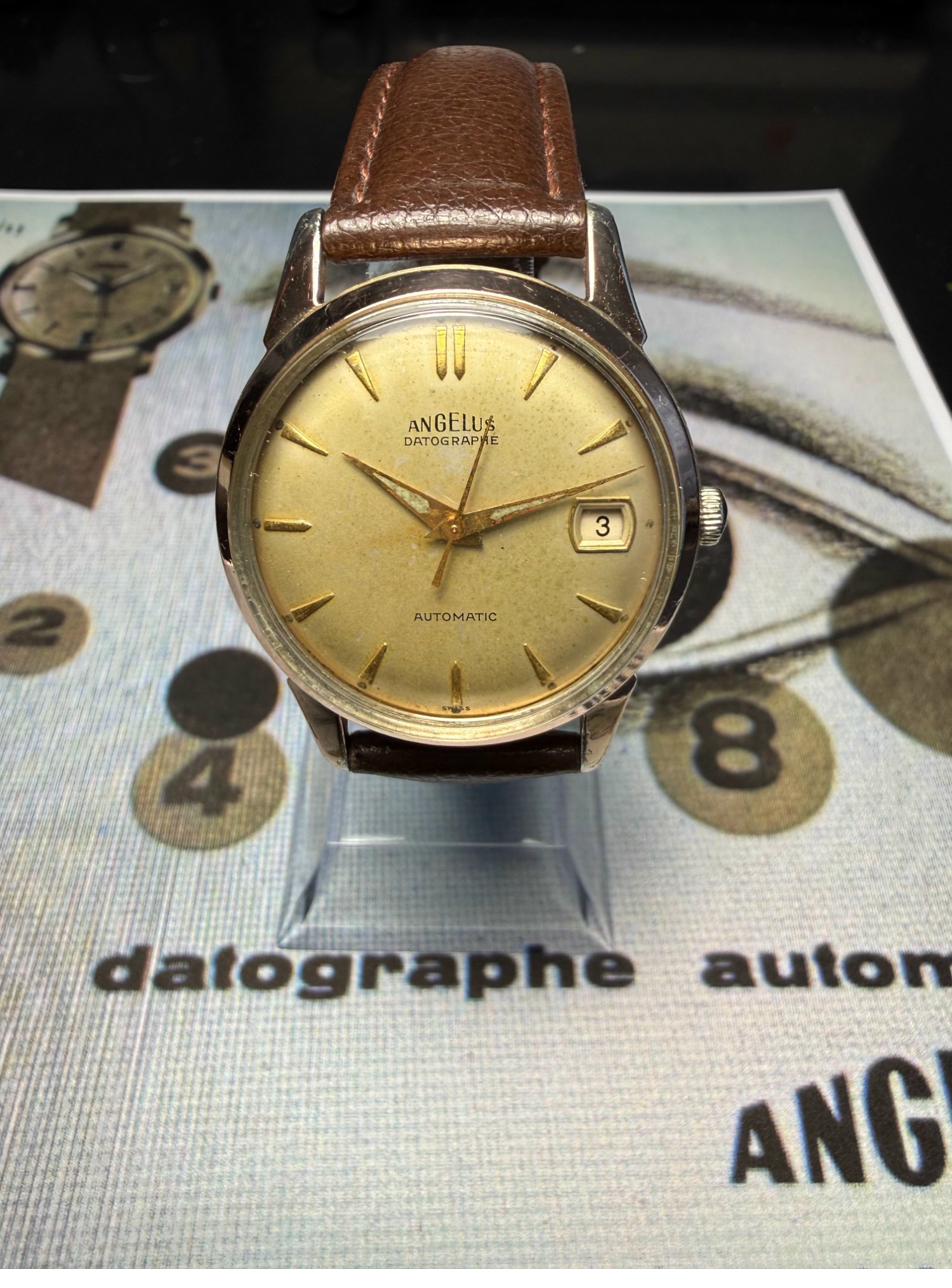
Among collectors, the Angelus name is often tied to chronograph legends like the Chronodato. Yet in 1958, Angelus quietly launched a remarkable wristwatch that marked a turning point in the company's history: the Angelus Datographe. Slim, elegant and technically forward-looking, it remains one of the brand's most underrated vintage models.
A "Rapier Thin" Automatic Calendar
In its original 1958 advertisement, Angelus described the new model as "Rapier thin automatic calendar." The Datographe was built around the A. Schild 1701 automatic movement (21 jewels), fitted with Angelus' own ultra-slim date module — one of the thinnest automatic date watches of its era, long before ultra-slim automatics became fashionable across Switzerland.
A Transitional Landmark in Angelus History
The Datographe sits at a crucial moment in the timeline of Angelus. By 1958, the celebrated in-house chronograph era (the SF 215, SF 217, SF 250 family) was ending. The Datographe was the first true Angelus dress-watch line positioned to compete in the emerging "thin automatic" segment — and one of the last purely Angelus-driven product lines before the Evaco SA era.
1958: The Same Year Angelus Made Repeater History
Remarkably, 1958 was also the year Angelus released the Tinkler — the world's first automatic wristwatch with a quarter repeater. A pristine example sold for $10,000 in 2013. The Datographe and the Tinkler together illustrate the creative high point Angelus reached in the late 1950s.
Why the Datographe Deserves Renewed Attention
Historically important, technically refined, and with timeless mid-century aesthetics — while Angelus chronographs command strong prices, the Datographe remains an accessible and undervalued entry into Angelus' golden age.